
Number of Visitors
During the June 23, 2026, workshop meeting at City Hall, Councilman Loren Anderson stated that only 771 unique visitors have been to the Museum at Keewaydin in the last two years, then the Tri-City Hearld published that statement without reaching out to us for comment.
One of our board members emailed him to inquire about the source of that figure, but he has not yet responded. It is likely he is utilizing AI-based location-tracking software. Such tools track individuals via smartphones and are often flawed, particularly for small-scale applications. They fail to account for anyone without a smartphone—which includes most children and many seniors—and they do not track individuals who have disabled location services. Furthermore, regarding the metric of "unique visitors," a person is only counted the first time they visit a location, whereas we have many repeat visitors.
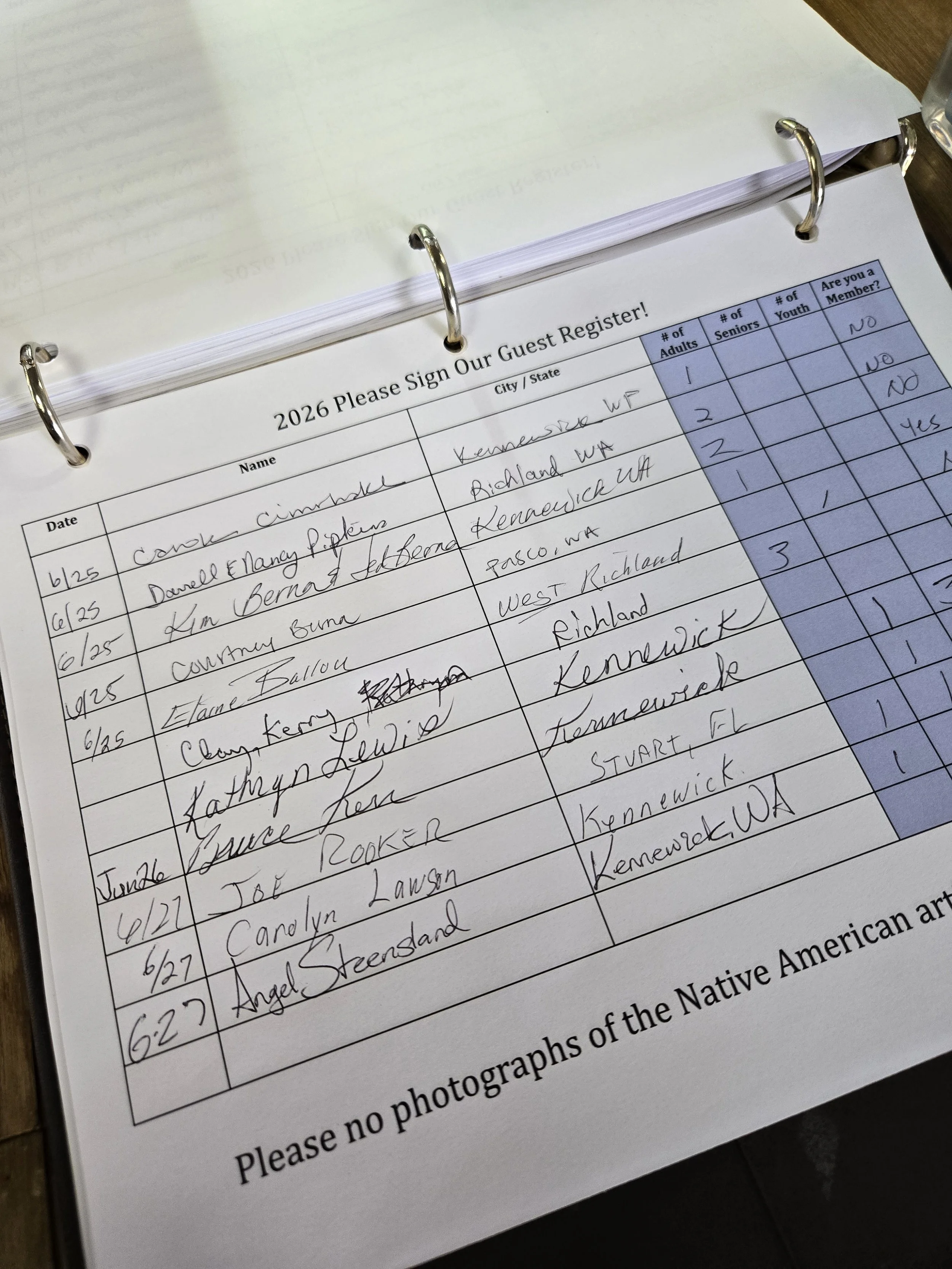
This figure in no way reflects our actual visitor count. As of today, we have hosted at least 602 visitors in 2026, despite being closed for six weeks in February and March for flooring replacements. In 2025, we recorded at least 900 visitors. While these figures are not as high as we would like, Councilman Anderson's statement is incorrect and misleading.
An Urgent Update Regarding the Museum at Keewaydin
Our future at 205 West Keewaydin Drive is still uncertain, please learn how you can help.
A Critical Moment for the East Benton County Historical Society
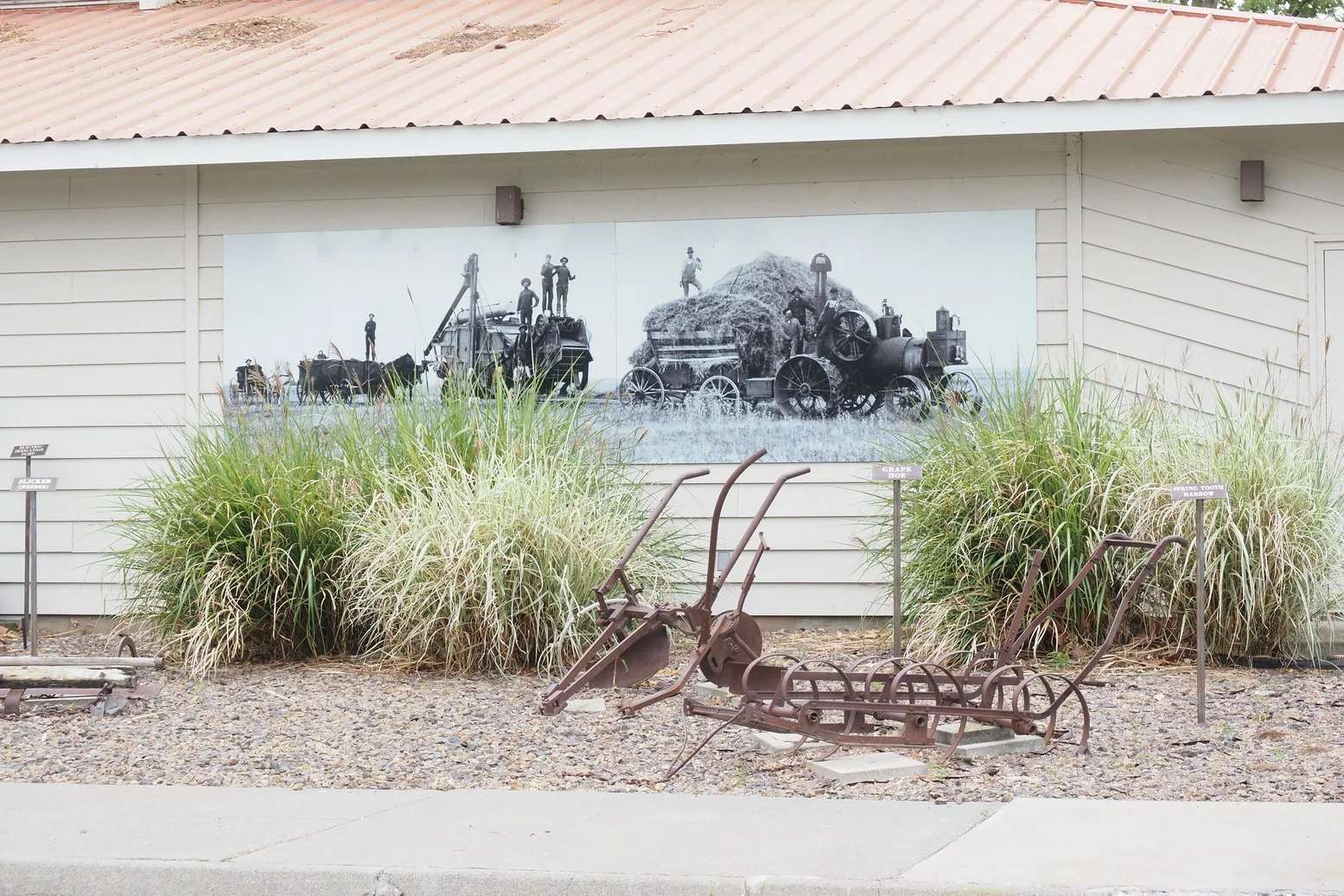
Our future at 205 West Keewaydin Drive is still uncertain, the only thing the city council could agree on regarding the building (at the workshop meeting on June 23, 2026), is that they do not want to remodel the existing city hall. That was the only plan out of four options that did not affect the Museum at Keewaydin. You can see the plans for yourself here, by downloading the presentation. There is also a printed copy at the museum.
The City of Kennewick is exploring options for a new City Hall, and the updated plans still hurt the museum. Revised plan Option 1A gives us 3,500 sq ft of space within city hall. This is a significant reduction of our exhibit space and leaves us no space for artifact storage or offices. Designers of this plan used the Moses Lake Museum and Art Center as an example of what a museum inside of city hall could look like. What they failed to mention is that the City of Moses Lake is cutting ties with their museum by 2029, a devastating blow to the history and community of Moses Lake. This plan has the city spending millions of dollars of taxpayers' money to reduce our space and force us into city hall, where we will be treated as an afterthought.
Option 1B and Option 2 retain the existing museum structure but eliminate access to our basement garage door. This entrance is not only an emergency exit but also essential for transporting large artifacts. Furthermore, the plan relocates parking significantly further from the entrances of both the museum and the community center. This creates an accessibility concern for disabled and elderly visitors and volunteers. All options being considered will expand green spaces and/or hardscape surfaces in Keewaydin Park. The landscaping around the museum and Keewaydin Park is already neglected due to the Parks department being spread thin.
Please join us in advocating for the preservation of the Museum at Keewaydin. Let's protect our past to enrich our future.
How You Can Help
Sign the petition if you haven’t already, to urge leaders to reconsider the demolition plan.
Show your support by coming to the July 7 City Council meeting. The meeting begins at 6:30 with citizens' comments. If you're not comfortable speaking, just showing up shows you care. You can pick up a button at the museum during our regular hours.
Write to your city council members sharing your thoughts on the importance of preserving the museum.
Send physical letter here:
[Council Member Name]
Care of City Hall
210 W 6th Ave
Kennewick, WA 99336
You can also email the council members:
Jason McShane, Mayor - Ward 1 Position 1
Jason.McShane@ci.kennewick.wa.us
Chuck Torelli
Mayor Pro Tem - At Large Position 5 (All Wards)
Chuck.Torelli@ci.kennewick.wa.us
Loren Anderson, Council Member - Ward 2 Position 2
Loren.Anderson@ci.kennewick.wa.us
Brad Beauchamp, Council Member - At Large Position 6 (All Wards)
Brad.Beauchamp@ci.kennewick.wa.us
Jim Millbauer, Council Member - At Large Position 7 (All Wards)
Jim.Millbauer@ci.kennewick.wa.us
John Trumbo, Council Member - Ward 3 Position 3
John.Trumbo@ci.kennewick.wa.us
Brad Klippert, Council Member - At Large Position 4 (All Wards)
Brad.Klippert@ci.kennewick.wa.us
Urgent Message Regarding the Museum at Keewaydin
Urgent Message Regarding the Museum at Keewaydin
A Critical Moment for the East Benton County Historical Society
A Critical Moment for the East Benton County Historical Society
May 27, 2026
Dear Members and Friends of the Museum,
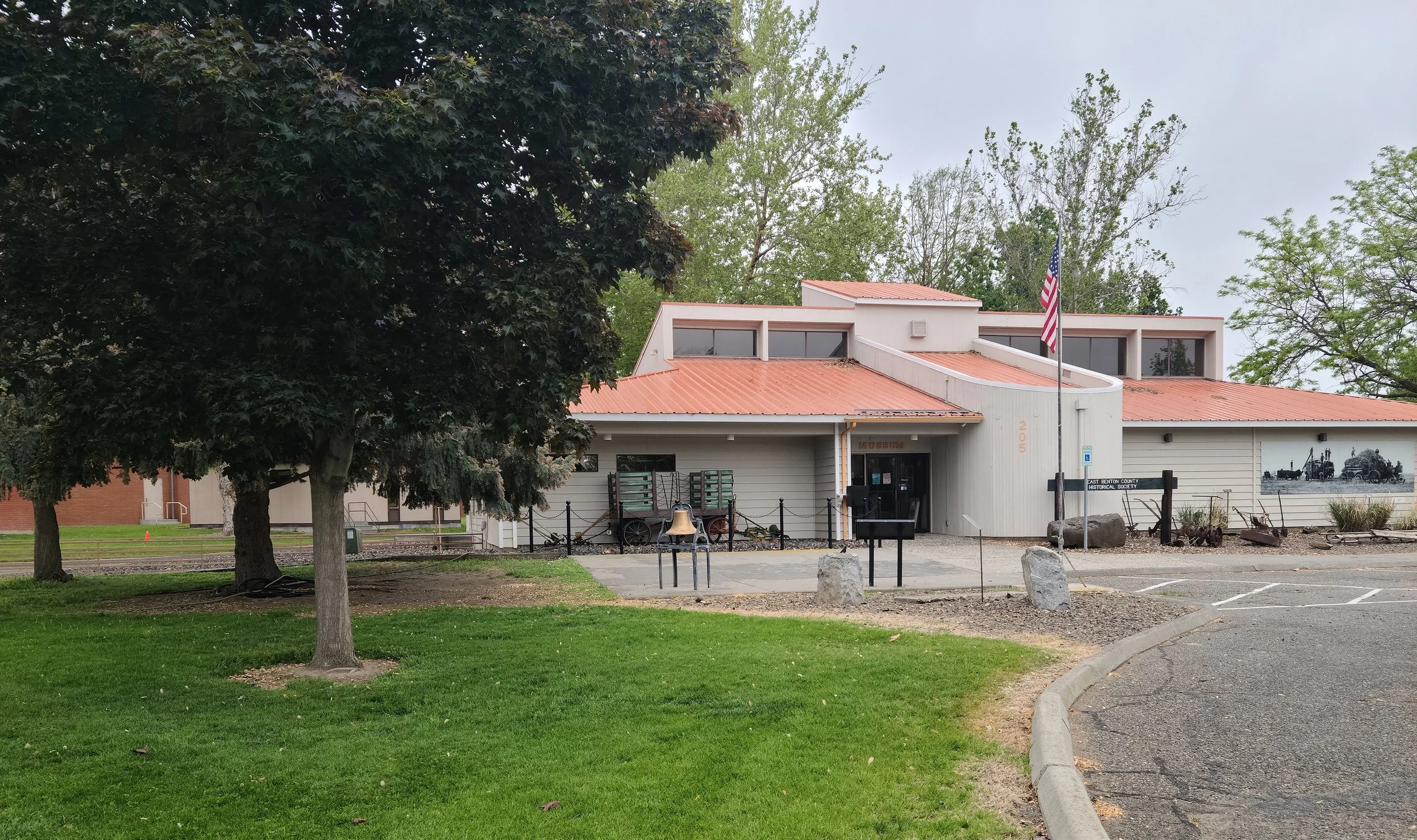
I am writing to share critical information regarding the future of our home at 205 West Keewaydin Drive. The City of Kennewick is currently exploring options for a new City Hall, and one of the plans presented by their architectural firm involves the demolition of our museum building.
The East Benton County Historical Society built this museum through the generosity and labor of our community. Names like Mueller, Gravenslund, Lampson, Bateman, and Spaulding are literally built into these walls, alongside the contributions of 110 service groups and local businesses. Our building is a nearly 9,000-square-foot repository for the stories of our pioneers, railroad workers, and farmers.
The Proposal
One of the city’s current plans suggests replacing our nearly 5,000-square-feet of exhibition space—with a mere 500 square feet of space inside a new city hall. This represents a 90% reduction in our ability to display our collections, such as our one-of-a-kind petrified wood floor, military exhibits, and the vast projectile point collection.
Our Investment and Rights
The Historical Society turned the museum building over to the City of Kennewick in 1981 with the understanding it would be our long-term home. We currently hold a 50-year lease, with an option to renew for another 50 years. Furthermore, we have continued to invest heavily in the facility, including $20,000 for exterior painting in 2022 and over $36,000 for new flooring earlier this year.
How You Can Help
We are being proactive. While the city has assured us they are in the early planning stages, we must act now to ensure the museum remains a negative force against demolition and a positive voice for preservation.
We ask that you join us in these efforts:
Write to the City Council: Please share what the museum means to you and your family. Your personal stories are powerful. See the second side for the addresses.
Sign the Petition: We have a petition on change.org, you can sign it here: https://c.org/tKZWjkg2xj
Write a letter to the editor of the Tri-City Herald
We are the keepers of the people’s things. The pioneers, railroad workers and farmers that founded Kennewick. With your help, we will continue to keep them safe for future generations. Losing our building wouldn’t just mean a loss in that investment. It would be a loss for the community that helped create it over 40 years ago.
Sincerely,
Misty Ayers, Museum Administrator
Museum at Keewaydin
Send a physical letter here:
[Council Member Name]
C/O City Hall
210 West 6th Avenue
Kennewick, WA 99336
You can also email the council members:
Jason McShane, Mayor - Ward 1 Position 1
Jason.McShane@ci.kennewick.wa.us
Chuck Torelli, Mayor Pro Tem - At Large Position 5 (All Wards)
Chuck.Torelli@ci.kennewick.wa.us
Loren Anderson, Council Member - Ward 2 Position 2
Loren.Anderson@ci.kennewick.wa.us
Brad Beauchamp, Council Member - At Large Position 6 (All Wards)
Brad.Beauchamp@ci.kennewick.wa.us
Jim Millbauer, Council Member - At Large Position 7 (All Wards)
Jim.Millbauer@ci.kennewick.wa.us
John Trumbo, Council Member - Ward 3 Position 3
John.Trumbo@ci.kennewick.wa.us
Brad Klippert, Council Member - At Large Position 4 (All Wards)
Brad.Klippert@ci.kennewick.wa.us
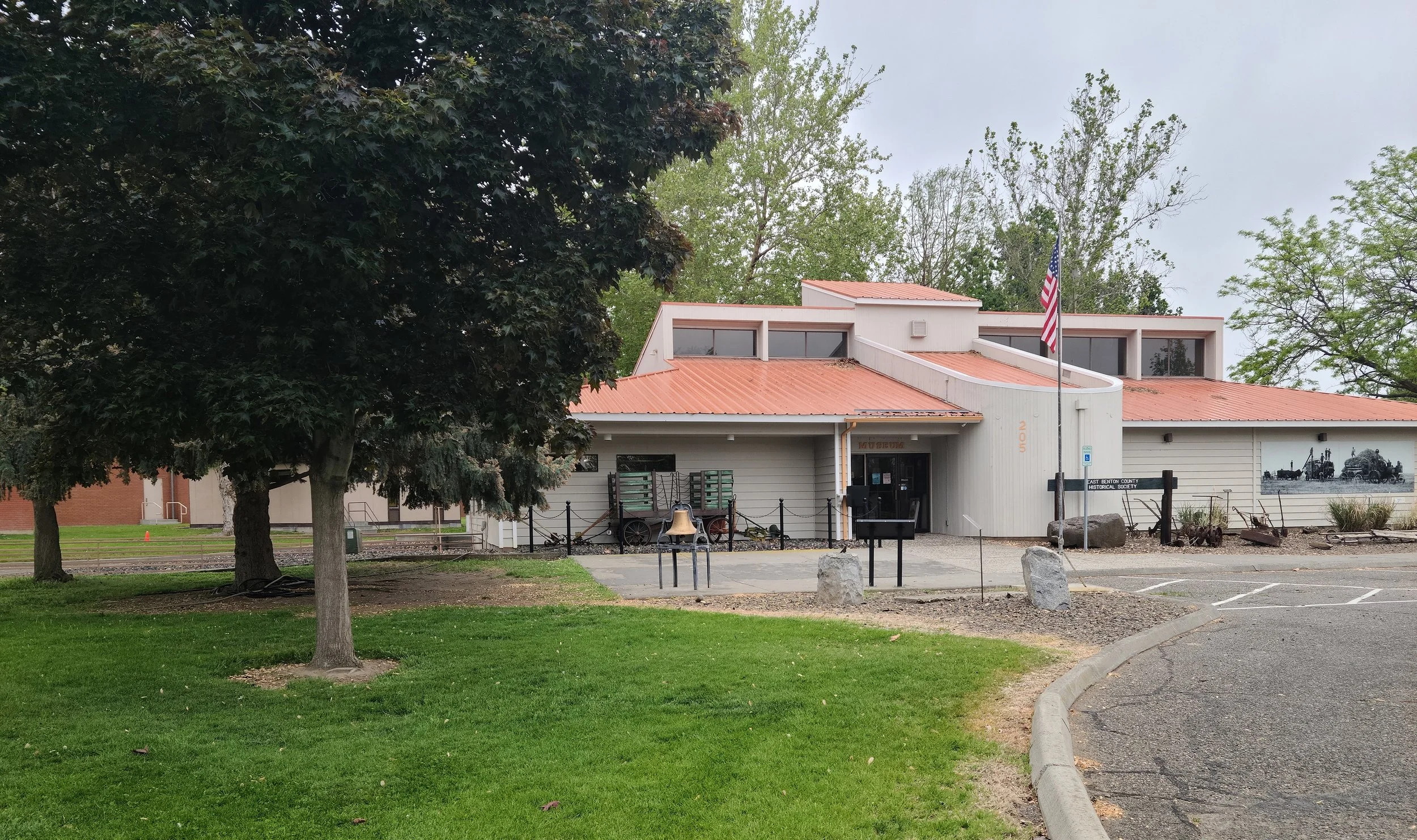
The Museum at Keewaydin was built by donations from Kennewick citizens and opened in 1982.
Growing up Spaulding: life in the early days of Kennewick
BY GENE SPAULDING SR. (written in 1989)
I remember his name, but I have no idea of what the first friend I ever had looked like. He did something he didn’t have to do and of course I’ll never know why, but it set itself in my memory—forever.
I was three and a half years old and in tow with my Mother and Father who came to Kennewick for what turned out to be a long stay. Several years out of Medical School and having practiced in two other towns, I think my Father hoped this would be the last stop. It was.
The big 1906 fire in San Francisco meant he missed a formal graduation from the College of Physicians and Surgeons and it meant the City by the Bay held no more attractions for my Mother. Coming to Washington State, mainly because of the glowing tales from his parents in Pullman, they settled in nearby St. John for a few years. To meet young “Doc” Spaulding was to feel an instant affection for him. He held that quality all his life and I have heard dozens of people describe him. Describe the various facets of his personality. Sadly, it was probably best done by Courier-Reporter owner and editor, Ralph Reed, when he wrote the Doctor’s obituary, in 1940. Anyway, in his day of practice, one didn’t have to wade through a receptionist or two, pay cash in advance and fill out a two-page form of your life history including some data on how you were going to pay for services rendered. When you came to a country doctor in the early part of this century, you got your medicine, your advice, and a comfortable feeling that you were going to make it. You talked about the bill later. But in St. John, the area was poor, there was another good doctor in St. John, and if a green spot appeared in the distance, you gave it more than a casual glance. In 1911, Pasco was getting lively publicity and we moved there. Six months later, the agriculture of Kennewick looked a little better and we made our last move. November 1911.
And that is where my friend comes in. His name was Verl Thorp and I am guessing that he was maybe six or seven years old. He didn’t know any of us. We were just two old people (age 37) and a three-year-old kid getting off a train from Pasco on a bitter cold and snowy day. He had a sled and he hauled me and some luggage the four or five blocks to the house we were to live in. He just offered to do it and gained the thanks of some very grateful people. The friendliness continued. His frequent visits to “come and play”, his errand running and willingness to help in any way eared the accolade of “such a nice boy” from Mother.
In 1914, Dr. Spaulding bought a new Buick. I remember it, and Verl about lost his mind from the pure beauty of it.
In 1915, Verl Thorp died of a ruptured appendix. I remember only the solemnity of the graveside services and the very deep grief of my parents. I remember also that on many occasions through the years, I have purposely gone to his gravesite and stared for long moments at the burial marker bearing his name. I am not capable of describing my thoughts.
Let’s interject at this point that I shall not make much of an effort to place my thoughts and memories in good chronological order. I have on the gentle hope that this will make acceptable reading.
In those days, ice was delivered to your house to replace what had melted. If you wanted ice, you put a sign in the window that said ICE. No sign, no ice. But the ice man came every summer day in his dilapidated wagon because someone always needed ice. A highlight of a dull summer day would be to snitch a few pieces of ice off the back of the wagon, little pieces that is. If you got greedy and tried for a big piece, the ice man would snap a horse whip in your general direction, and you had all the ice you were going to get that day.
This was an era when you just went out and played. No planning, no instruction. You just played. What you played depended on the season of the year, who you ran into, and what kind of ball showed up. No adults included in boys play in a small town. If one DID show up and wanted to direct us into some kind of game, his style, we would tolerate him for a while and then slowly disappear, like maybe we would pretend we were looking for the ice man. Usually, we would lend up playing Indian until we were alone again and the adult either lost interest or else could take a hint. I don’t imagine we were paragons of tact or diplomacy. Dr. Spaulding seemed to be an exception to this rule. On occasion he enjoyed being around but never interfered, never told us how to do things, and was an excellent ditch watcher. That was about the only time we would willingly abide an adult—to let them watch at the ditch. The ditch, as it does today, ran through the whole town and was as wide, dangerous, and dirty as it is today. The irrigation ditch made an average of claiming a kid a year and we knew it so in the case of the ditch, an adult was acceptable, like oatmeal—necessary.
In 1912, the streets of Kennewick were dirt in the summertime and mud in the winter. This was a great inconvenience to a fastidious lady, a bother to the men, and an absolute delight to the kid who had an insatiable impulse to kick up a dust storm when it was dry and unable to resist a slap of the foot into the middle of a puddle when it was wet.
In about 1915, Bill Morain tarred the main street, and being one of the insatiable ones, I remember burning my bare feet so bad it took medical attention. That was the same year that Elmer Crosby, Glenn Johnson, and I took (stole?) Frank Maupin’s canvas canoe and took off for Clover Island. Our departure was about from about where the Blue Bridge is now and using board for paddles, it didn’t seem any more than an afternoon adventure. It was called Clover Island then as now, but it was a different island. And the Columbia was a different river. She was no Lake Wallula, Late that afternoon, we came back and couldn’t figure out why so many people were watching us from the shore. When we got close enough to shore to see our parents, and dozens of others, waiting we knew why. My dad only got mad once or twice in a decade and I guess he decided this was as good as any.
By 1915 we had moved to the house on Kennewick Ave., presently numbered 418. I don’t remember much about the house we first lived in, located on the property where Washington Mutual Bank now sits, and the house is long since destroyed. But I remember the house at 418. At this writing, it is owned by Thomas Moak, librarian and devoted worker volunteer at the East Benton County Historical Society. He has done extensive remodeling, and I visit it quite frequently. Lovely old home. In 1917, it was equipped with all the then modern necessities. Indoor bathroom, wood and coal range stove with hot water coils for the whole house wrapped up in the kitchen range fire box. Pretty fancy. I remember a heat gauge on the oven door which didn’t work very well. Getting kindling to start the fire and keeping the coal bucket full was one of my daily chores. But we had no sewer or septic tank, just a cesspool. We couldn’t play over it as it was always quite soft and spongy. It was spongy when we moved in and spongy when we moved out in 1917.
Centrally located for our side of town, it was always a collection spot for lots of kids and lots of fun. Names like Virginia Graham, Don Dunlap, Roy Warnock, Eloise Craver, and of course Louie Huntington and Bob Mattecheck come to mind. Other than Crosby (son of Dr. Crosby), all the above are pictured in the 1964 album. (the year of the big High School Reunion.) Many memories flood my mind of the things we did in those days. We went to school and then fooled around on Saturdays and Sundays. Mostly we amused ourselves, as 7-year-olds do today, though as told above we didn’t have organized play. If we scrounged up a nickel or dime, we would go down to the Vibber-Gifford Drug Store and buy one of those new-fangled chocolate-covered ice cream bars. Called Eskimo Pies.
I had a dog named Punk and we used to hunt. Once you got south of Kennewick High School, it was wide open sagebrush. Further south were vineyards, orchards, houses with families and always attached to five or forty acres of something on which all could make a living. The Fraziers, Yosts, Greens, Withers, Washburns, Olivers, Stulls are names that come to mind and there was Riverview Cemetery which I could visit with my friend, Verl Thorp. During those years I became closer to the friend with whom I kept in touch with all these years, Louie Huntington.
On the then unpaved Washington Street was the aptly name Washington Grade School. It was here that I met another friend and benefactor, Miss Membach, my first-grade teacher. (They were all “Miss” then as married women were not allowed to teach school.) Miss Membach had an affliction that my Dad called “double congenital dislocation of the hips”. She waddled when she walked. You don’t see it anymore because the medical profession has learned how to fix it whe noted at an early age. I remember we used to make fun of her, but not for long. We quickly fell in love with her and even at our tender years, we knew she had something she was giving us. After one year with Miss Membach, every kid of us could read at an astonishing level. I’ve never had another teacher her equal. Our playfield was located where the present PUD building stands. It was of clay and rock and about the consistency of concrete. Great place for marble, stick ball, and other activities, including breaking an arm or leg, which some of us did.
In 1916, Dr. Spaulding was driving Chalmers cars. They really weren’t very good automobiles, but we drove them because Fuzz Reser sold them. Something like broken axles or leaky radiators always seemed to affect them. I remember one time we drove to Seattle, an arduous two-day trip. With an early start, you made it to Ellensburg the first day, with an overnight stay at the Antlers Hotel. The second day was the real test. An all dirt and gravel road that would test the devil, but somehow you made it and when you came to a paved road, you were almost to Seattle. A welcome sight. It was on a paved road in Seattle that an axle broke. The trip was made in company with the L. E. Johnsons, for in those days you traveled the “buddy” system, if possible. On an occasion or two we drove to Portland. Though the roads were better, it was a tortuous and twisty route, and it took time. Try the Memaloose Loops or Vista Point on your next trip to Portland and you will wonder how those vintage cars ever made it. Though off the freeway, those roads are still kept up and are there to be traveled and enjoyed.
I don’t think as growing kids, our lives were any different than others in comparable sized towns. You made your own fun. You had to, for there was no alternative if you were going to do anything but sit. We threw rocks at any thing that moved, played marbles, dug holes and caves, broke windows if they got in the way, played baseball with a stick and tennis ball, pulled legs off bugs, went to the bathroom outside when we could get away with it, went to school because it was fun to learn something and I don’t remember any “peer pressure”. Our play was not organized by the city or any organization or our parents, and they—the parents—asked only that we keep out of trouble, go to school, and come home for dinner. At night with no TV or radio, you had only to read or study or do nothing.
My Dad seemed to enjoy my company and I certainly enjoyed his, so I went with him on his calls, where and when I could. It is interesting to look at his daily records and see where he was paid $2.00 for office calls, $3.00 for house calls, and four bucks if it was “out in the country”. $35.00 for a baby (full nine months care), $10.00 for helping another M.D. with an anesthetic. Those records are here and available to any who might be interested. (the foregoing circa 1920)
Some of those trips to the Horse Heaven were real hairy. Spike and Tack Ferrell had a livery stable on what is now Albany Ave. directly south of the Tri-City Herald building and this is where he used to rent a horse and buggy for rugged winter trips. Some of those trips were beautiful. Snow on the ground, clear, cold, and with an unlimited view from about where the Washington State Patrol is now located, the Kennewick Valley was an overwhelming sight even to an 8 or 9-year-old kid who is usually not overcome with viewing. All this with black smoke coming out of some of the chimneys with a sight no artist would dare try to paint. My mind still runs faster than my fingers and I tend to tell stories out of sequence.
Let’s go back to 1915 or 16 on one of our trips to Seattle. Being as rugged as automobile trips were, we made most of our trips by train--the good old Northern Pacific, now non-existent. On one such trip during the years above-mentioned I found out I had a sister named Evoril. In truth, she was a half-sister and here is another wild chapter in this writer’s history.
My mother, Adelaide Jordan, was born in Red Bluff, California in 1874, same year as my Father, however she married when she was 18 or 19 years old. She married a military man, name of Marshall, who was an officer in the infantry. Evoril was born to them in 1895 or 1896. I always thought that Evoril was an uncommon and very pretty name. My mother was later divorced from Marshall and getting a divorce in those days was well, frowned upon by one and all. When she married Dr. Spaulding in 1900, the Spaulding family was not all that enthusiastic over the matter. A lot of things happened during that era on which I was never informed and of course will never be. Who raised Evoril? Her maternal grandmother, I think. Why didn’t anyone tell me?
In 1917, the Dr. joined the Army and became 1st Lt. L. G. Spaulding after a period of training at Fort Riley, Kansas. It was World War I, and everybody was mad at the Germans. For lack of knowing what else to do, my Mother and I stayed in Kennewick until the Dr. was permanently stationed at Savanna, Illinois. He had good officer housing and in 1918 we joined him. Those were the days when trains were one the finest methods of travel. The other was by luxury “steam ships”. (We traveled to San Francisco by boat in 1915. Pan American Exposition. All I remember was the boat.) The trains were clean, on time, great to ride and sleep, and the dining cars were the equal of today’s best restaurants in service, attention, cleanliness, and fine cuisine.
I had a number of new and exciting experiences at the Savanna Proving Grounds. Primary purpose was to test and experiment with the big cannons and guns before they were sent overseas. We stayed there a year or more, returning to, of all places, Walla Walla, where the Dr. hoped to practice when he got out of the Army. His longtime and good friend Dr. Keylor was instrumental in this decision and wanted Dr. Spaulding to practice with him. The war was over and he thought his discharge was a matter of weeks. It didn’t turn out that way, for he was not released until April or May of 1919. One of the last and nicest things that happened to him when he was discharged was that the personnel of the proving grounds gave him a beautiful and expensive watch with glowing and sincere words of praise inside. It was a very meaningful thing and can you imagine a bunch of soldiers giving an officer such a gift and send off. Gene Spaulding Jr. has the watch now and I hope he will see to it that it stays in the family for generations to come. Priceless item in this family history. For many months prior to his coming to Walla Walla, I had been hearing my Mother complain of being ill. It frightened me and I remember lying awake nights wondering what to do. For the more than a year we lived in Walla Walla, just the two of us, our housing was at the Dacres Hotel. One room, bathroom down the hall, $1.00 per day rent and all of our meals were at nearby restaurants. It is 1919 and to an 11-year-old, that wasn’t such a hardship. To her, an attractive 45-year-old, it must have been unbearable, even if she hadn’t been ill. Though I didn’t know it, it had to be a miserable time for both my parents. So, when the Dr. got back, he found a sick and distraught woman who desperately needed some pretty intensive medical attention.
He started his practice in the Drumheller building, found a home to rent, and the situation started to ease a little. In November, she entered the hospital for surgery, and on December 12, 1919 Adelaide Jordan Spaulding died from post-operative peritoneal infection. I didn’t realize until years later how terribly stricken he was. They were very fond of each other and 19 brief years of marriage was simply not enough. Eleven-yearold me was about all he had to cling to. I shall always remember every detail of that period of travail. The phone call to come to the hospital. I ran for blocks from where we were living. The nurse’s words to me of my Mother’s death. The undertaker—the body “on view”—the color of the casket—all too awful for further description. We buried her on the 15th of December with a temperature that day of 30 degrees below zero. My father and I did not get out of the car. We simply watched the proceedings from inside the “family car”.
Well, you take it one day at a time after something like that and things did not get better. The Dr. didn’t have a thriving practice, and he was getting letters and phone calls urging
him to come back to Kennewick. Fo a few months we commuted, and then in the summer of 1920 the two of us moved back to Kennewick. It was our last move from
these stakes. And what a providential move it was. His grief was such that I question he could have continued practicing or even living if we had not come back to the helping hands of his friends in Kennewick. The Giffords, the Vibbers, the Sherks, and others all helped to bring a smile back to his face, and I settled down to get an education.
Eight grade, ninth grade on—I can’t think of a single thing that would be of interest to tell—or to read. I learned about girls, had my escapades with wine and beer, learned to smoke when I was fourteen, and did a lot of hunting with my friends Lou Huntington and Bob Mattecheck. Bob was the only one of us who could borrow his Dad’s car. Those were the days when you could drive halfway to Finley and have lots of water to hunt duck and farms to hunt pheasants, quail, etc. We always got our share. We had an orchestra (not a very good one) and I played a saxophone (not very well). Kennewick girls seemed like sisters, so I dated Pasco girls, which in those days was a despicable thing to do. Even got in an occasional fight over it. My goodness, as I look back, every girl I dated and had a big crush on is gone now. Mary, Viola, Irene, Peggy, Katie and some names I am sure I have forgotten.
In 1923, the Mattechecks decided to move to Seattle, and it was thought it would be a great idea for me to go live with them, and I attended Lincoln High for one year. And then it was back to graduate from Kennewick High School in 1926. But all this is as dull to write as it is to read. The years 1920-21-22-23-24-25-26 WERE dull and though I may make reference to them as I think of them, I would be better off to relate more family history. Maybe I should tell you of the burden of being the only child of Dr. Le Grand Spaulding.
Here was a truly rare and fine man who in his community led the field in matters of medicine, community volunteer work, his Masonic Lodge, and was father confessor to all who knew him. To be his son was not as easy task mainly because people expected too much of me, this regardless of age, whether I was 10 or 30. I was never a ”chip off the old block” and while he was alive, people too often were not hesitant to tell me just that.
Le Grand Spaulding was born in Petaluma, California on June 25, 1874. There were brothers George, Roy, and Frank, and sister Della. They all grew up in Petaluma,
Healdsburg, and Point Arena, California. As a boy of 17 or 18 years old, Le Grand
migrated to Santa Barbara to be sheltered and helped by his Uncle Horace Lamb. (his
Mother’s brother) Horace Lamb was an M.D. and was the one who got him started in
Medical School, the School of Physicians and Surgeons in San Francisco.
Roy was killed in a lumber yard accident at a young age. He was fooling around the
piles of lumber and it tumbled, crushing him to death. He is buried in Point Arena.
George became an accountant and was studying law in Pullman in the early 1900s, and
from the letters we have, was the best correspondent Le Grand had. George and Le
Grand worked and sent money to Frank, enabling him to get through Dental School. I
have no further record of George except to know he married and died sometime
between 1910 and 1925. Frank married Floy, had Frances (1906--) and practiced
dentistry in Portland until he died in 1949. Della married Adolf Chenoweth and had four
boys and as of this writing, 1988, three are alive, scattered from California to Spokane,
WA. The father of the Spaulding clan was Francis Marion. He was a wagon maker, an
honorable profession of that day but somehow, neither Le Grand nor Frank cared much
about him. Maybe Della didn’t either, I don’t know. The thing that bothered his kids the
most was that he refused to help with the education of any of them. He had some
unfortunate facets to his personality. My Dad told me that he loved to stand on a street
corner in Walla Walla (where they retired), jingle the coins in his pocket, and brag about
“my boys”. He died in 1916. The Mother, Sophia, was an angel. The two boys and Della
took turns caring for her and I well remember her stays with us. In the early 20’s, with no
Mother in our home she was with us a great deal as companion, cook, and homemaker. A sweet, tiny, and dear person, she died in 1929 and is buried in Walla Walla beside her
husband. I think it is of interest to note that Sophia Augusta Lamb was born in 1850 and
came across the plains to California in a covered wagon in 1852. She didn’t remember
much of childhood but met her husband-to-be in California and was married in 1870?
Francis Marion Spaulding was born in 1847 in Illinois, went to New York, and the came
to San Francisco by boat. I know little else about his life until I knew him as a
Grandfather.
In 1926, the Doctor married Elizabeth McGahey. It was a marriage of convenience for
both of them. He needed someone to cook, keep house, etc. for the two of us and she
needed help with her two children. Though he educated both of her children, it was not
a successful union, and they were divorced in 1936. One of the better ones with
everyone mad at everyone else. Marjorie, the daughter, lives in Seattle today, and Bill,
the son, lives in Richland, retired from one of the companies that operated the nuclear
plants.
1926. I entered Whitman and managed two years there. Today I am of the opinion there
are too many counselors, at least not enough good ones to service the schools in which
they work. In my day, they had no such thing and I wish they had. I needed a counselor
because I was on the wrong track. My Dad’s great hope was that I, too, would become
a Dr. But it was not to be for a number of reasons. Basically, I didn’t want to be, but
more important, I lacked proper foundation in the sciences. Physics, chemistry, biology
etc. were total mysteries to me. On the other hand, because of Miss Membach, I was
very competent in reading comprehension and loved to do it. I truly needed some help
and advice and would have probably made a good teacher, history, or maybe a lawyer.
It is 1930 and I was out of school and out of work, so my Dad gave me $125.00 (that’s
the right figure) and I took out for San Francisco. Fooled around for several months with
Lou Huntington, and by then my cousin Harold Butler found me a job. Harold was the
husband of my cousin Vivian, who in turn was the daughter of my Mother’s sister, Edith.
They were all lovely people, but I knew them for six months, had not seen them before
nor since. Finis. (If some genealogist should happen on this and wish to inquire further, Harold Butler was a prominent citizen in San Francisco. Owner of several concessions
in the Ferry Bldg. home address 35 Aptos Way, San Francisco. No Zip Codes in 1930.)
In 1930, many of the trains on the Santa Fe railroad did not have dining cars. The
people who rode the train stopped to eat in restaurants which were located strategically
along the route from Chicago to Los Angeles. They were known as Harvey Houses,
being owned by one Fred Harvey. They were hotels and restaurants, and Harold got me
a job with the Harvey Houses. First stop—Barstow, California. They were very
respectable establishments, and you could give most of them a 7 rating out of 10. From
Barstow I went to Mojave, then Ashfork, Seligman, and the lovely Fray Marcos at
Williams, Arizona. Next Winslow, the best one on the line and designed by the
distinguished Mary Jane Colter. Read about her in the book named after her, in our
library. Arrived on a day in April 1934 and some friends set me up with a blind date that
night. Not a bad date. I married the girl on Mar 17th, 1935. It is still going on as of this
date in 1989.
From here on in I am talking to Scott and Elisabeth who may, I hope, be interested in
some of the pretty specific details of the lefe and time of there grandparent, Gene le
Grand Spaulding and Gertrude Rhyan Spaulding.
We left Winslow and came to Kennewick, (something I had never planned on doing),
primarily because Dr. Spaulding wanted us. He was ill, knew it, and needed someone
he loved nearby. He was a doctor and he knew about dying. His desire for our coming
to Kennewick was simply his wish to be with those he loved the most for the years that
were to come. But as said in Genesis, in the beginning, in my formative years there is
little doubt that I acted as all kids, age one to eighteen, act. Pretty much self-centered,
prone to be polite and considerate to the extent we were taught. It wasn’t until one is in
the range of 25, give or take a few, that you begin to comprehend and appreciate the
good things with which you are surrounded. Sure as hell I didn’t nor did I respond to,
this kind and gentle man as I now wish I had. It is easy to regret for a lifetime about the
things you wish you had done.
Suggested title: Growing up Spaulding: life in the early days of Kennewick
Gene Spaulding, Sr., writing in 1989, tells stories of growing up in early 20th century
Kennewick and of the Spaulding family. This story basically ends in 1940, when his
father Dr. Le Grand Spaulding died. After World War II, Gene ran a successful
insurance and real estate business in Kennewick. He was also known for his community
involvement being chosen as both Kennewick Man of the Year and Tri-Citian of the
Year. He was one of the key people who made our Museum at Keewaydin possible as
he led the fundraising efforts and served as President over 40 years ago. Gene was the
longest-serving commissioner of the Port of Kennewick (1963-1998) and died in 1999 at
the age of 90.
Remembering Mount Saint Helens

Mount Saint Helens
The May 18, 1980 eruption left a crater approximately 1 mile wide and 2 miles long.


May 18, 2025 is the 45th anniversary of Mt. St. Helens blowing its top. Don’t miss our Mt. St. Helens exhibit and events! Learn more here.
BY GALE METCALF
“Vancouver, Vancouver, this is it!”
Seconds after David Johnson broadcast those words at 8:32 a.m. on May 18, 1980 to the Vancouver headquarters of the United States Geological Survey, he was dead.
Seconds later, so were many others camping out, or on an early morning outing traveling the forest roads or hiking the paths of Mount St. Helens that Sunday morning.
One of southwestern Washington state’s most pristine settings overlooking Spirit Lake was blown to oblivion 45 years ago by a catastrophic volcanic explosion equal to 10 to 50 million tons of dynamite. It literally scalped the north face of Mount Saint Helens.
The summit of Mt. St. Helens was reduced from 9,677 feet to 8,363 feet with the blast that created a 1-mile wide horseshoe-shaped crater.
Within hours volcanic ash was falling on the Tri-Cities and eastern Washington. Within days ash had dropped to earth on sister states across the country to the east coast. It meandered into Europe and by early June, less than two weeks after the eruption, ash from Mount St. Helens had completed a round-the-world circuit and was back in Washington state.
Ever more ominous were the 57 confirmed to have been killed by the Mount St. Helens eruption, some of whom were never seen again.
Johnson, a scientist with the U.S. Geological Survey (USGS), was monitoring the mountain that morning from an observation post 6 miles away. He was the first to report the volcanic explosion which scientists expected due to with its repeated rumblings.
For 123 years, Mount Saint Helens had lay quiet. Eruptions had last began in 1842, and continued off and on until 1857 with smoke and ash spewing. On March 20, 1980, rumblings began again, an awakening sign not felt for well more than a century.
For the Tri-Cities and other eastern Washington cities, communities and locations even more severely impacted by volcanic ash, a change of pace was immediate.
Travel was halted. Plans were erased. Schedules were sidelined. Inconveniences became the norm.
It choked the freshness from the air in towns and cities, obliterated the sun from the morning sky, dusted away nature’s colors from its trees and landscape, leaving dull, eerie ghost-like remains to depress people’s emotions. Smaller eastern Washington school districts closed for the remainder of the school year.
Moses Lake, Yakima, Ritzville, Othello, Ephrata, Warden and Soap Lake received ash cleanup help from the Washington state National Guard, ordered by then Governor Dixy Lee Ray. Those activated included 70 Guardsmen from the 303rd Armored Battalion in Pasco. Bellingham’s 286th Engineers Company committed its heavy road working equipment to help Yakima dig out. Cleanup around schools, hospitals and downtown buildings became priorities.
Health authorities were cautioning people to limit exercise outside, and for those with breathing difficulties to stay inside as much as possible.
The public transportation of planes, trains, and buses came to a halt in the Tri-Cities, and motorists found blockades to roads they wanted to travel, as many state roads, including major highways in places, were closed.
Motels filled, shelters arose, travelers were stranded, and two local high school bands, Kamiakin in Spokane, and Hanford in Ellensburg, could not get home. Work at Hanford dropped with the limits of workers being unable to reach the site. Vacation and recreation sites in Washington state became ghost towns.
It has been described as the “largest historical landslide on earth.”
According to Wikipedia, “it remains the deadliest and most economically destructive volcanic event in U.S. history.”
Destructive and cleanup costs came to $1.1 billion to the losses of civil works, timber and agriculture.
Destroyed were 200 homes, 185 miles of highway, 47 bridges, and 15 miles of railroad line.
Individual stories grew out of experiences by many Tri-Citians.
A Kennewick man, his young son and a friend were fishing near Palouse Falls. They heard of the eruption and a light dusting of ash coming down on Benton City and around the Tri-Cities. They looked forward to seeing the dusting. Before they reached their car they, the car, and the road out were caked in volcanic ash. Visibility was almost nonexistent.
A group of white-water rafters from the Tri-Cities were running the rapids of the Wenatchee River and enjoying its spacing of tranquil waters. They were mystified by the strange looking cloud moving in when not a touch of breeze was in the air. They would end up holed in a Wenatchee motel for days until making a break for Seattle, heading down to Portland, and making their way home through the Columbia River Gorge.
A Kennewick woman employed and living in Othello was hitchhiking back to Othello when she and the highway she was on were soon enveloped by volcanic ash. She didn’t see a passing car the next three days and spent three nights sleeping in the ash off the side of the road before finally reaching her Othello home by walking the entire distance.
A Tri-City Herald reporter was visiting friends in Redmond that weekend. Enroute home, he and other motorists were stopped near North Bend and were told they could go no further east.
He returned to the home of his friends, followed reports on the radio, and then decided to head out south and perhaps find a story or two.
He found many.
There was the young man living along the Toutle River who escaped the river’s destructiveness caused by the blast. He was wearing pants at least three sizes too big, and securing them with one hand because he had no belt.
He took the Herald reporter to the river’s edge where the blackness prevented seeing anything, but where sounds of destruction could be heard in the tons of debris crashing into itself and the shoreline.
Boulders, houses, vehicles, and logs crashed downstream in a raging river 25 feet higher than normal. It tore at anything that got in its way. The night was eerie, inky black buttressed by the roar of destruction only a few yards away.
A Washington State Patrol officer, Trooper Tim Green, had been for several hours preventing traffic from crossing a bridge. Two bridges were at that location and troopers were keeping motorists from using either one for fear of them being weakened as piers were repeatedly pounded by heavy debris. Trooper Green would be on the scene for several more hours. The reporter shared food with the trooper who had no relief for hours.
The reporter made his way by back roads to a shelter set up for families who lost everything or who were threatened by the dangers imposed by post-blast conditions.
“It was cold, like you could feel the river,” one woman, weary in her tone, said as she was describing events impacting her and her family.
The reporter visited an animal shelter, that was overwhelmed, but still providing loving care for the many animals being brought in.
“Where’d you get the cat?” one shelter caregiver asked.
“Floating down the river in a boat,” the rescuer responded.
Rescuers of a beaver caked in mud and debris, washed, cleaned and prepared the beaver for return to the wilds. The reporter accompanied them to a pristine body of water in the forest unaffected by Mt. St. Helens and watched his happy release to the smiling of his rescuers knowledgeable in the ways of beavers.
Green Bridge dedictable 102 years ago


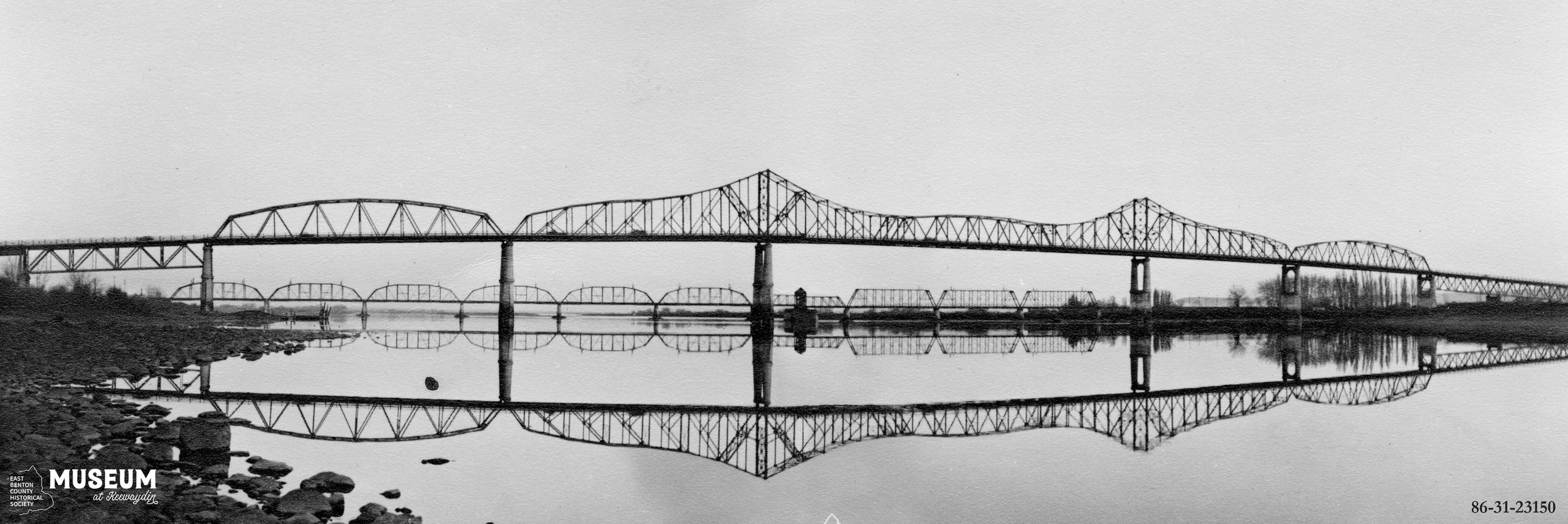
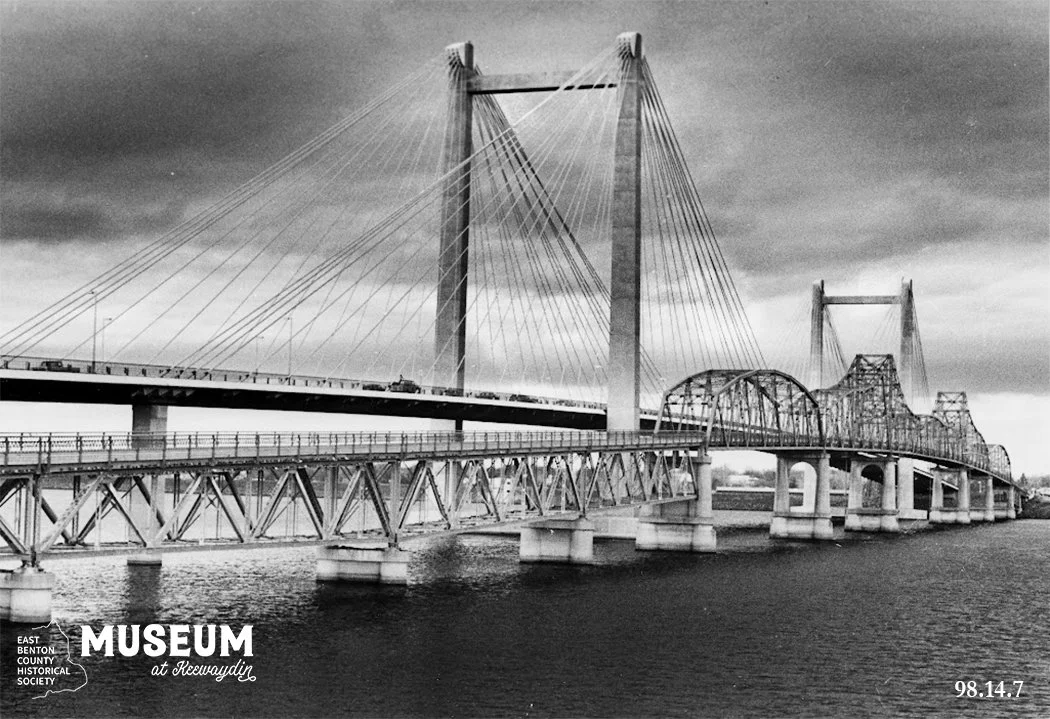
Photos: 86-30-78 The Green Bridge under construction in July 1922
86-31-32 A horse and buggy cross the Green Bridge
1961. 91-87-254 The first car across the Pasco-Kennewick (Green) Bridge. L/R Senator Jones, Senator stinson of Pasco, D.W. Owen of Kennewick, unkown.
98-14-8 Old Kennewick-Pasco bridge alongside the New Cable bridge over the Columbia River
86-31-23 Completed Green bridge with Rail bridge in the background.
By Gale Metcalf formaly printed in the Tri-Cities Area Journal of Business
A century ago, the automobile had not yet completely replaced the horse and buggy as the main way of getting around in the United States.
But, it was getting there.
But, getting to where you wanted to be – even with an automobile and the many more horses of power it had in its engine compared to the four-legged working machine out in the pasture – was another matter.
Good roads were limited., and many inherited natural obstacles.
If you wanted to drive your automobile from Massachusetts to Puget Sound on the Yellowstone Trail highway you had better be prepared to hop on a ferry between Pasco and Kennewick to complete your journey by car.
Until 1922.
The last road link on the Yellowstone Trail connecting the eastern seaboard of the United States with Washington state was completed with the opening of a 3,300-foot long, 185-foot high steel cantilever truss bridge across the Columbia River between Pasco and Kennewick.
It opened on October 21, 1922.
Right at this moment 100 years ago, building the bridge was underway. It would take one year to construct from beginning to end before opening the Yellowstone Trail to automobile surface traffic from its beginning to its end.
The Yellowstone Trail was the “first transcontinental automobile highway through the upper tier of the United States.”
It was established on May 23, 1912, some 10 years before the Pasco-Kennewick bridge was built. Running from the Atlantic Ocean at Plymouth, Massachusetts to Seattle and the Pacific Ocean, it passed through Yellowstone National Park.
A slogan of the day identified the Yellowstone Trail as “A good road from Plymouth Rock to Puget Sound.”
Plans for an automobile bridge linking Pasco and Kennewick were in the minds of some even before considerations of a Yellowstone Trail link.
A young Pasco attorney who had arrived in the tiny community in 1904, B.B. Horrigan, had thoughts as early as 1913. Horrigan, who served in elective and appointed positions in Pasco, who was a state legislator, and who became a superior court judge for the Benton-Franklin-Adams County Judicial District by appointment from Washington Governor Mons C. Wallgren in 1945, did not have funding at his disposal.
It came in 1919 when a representative of the Union Bridge Company, Charles G. Huber, sold $49,000 worth of stock to finance building the bridge, the first of its size paid entirely by stock sales.
Its dedication brought dignitaries and visitors from throughout the state, and brought significant optimism to what the new span might mean to the state’s economy to the two towns that now truly became the “Twin Cities.”
The Kennewick Courier-Reporter wrote then: “The day the bridge was opened to traffic, a new era dawned for each community.”
On its first day tolls were 75 cents a car, 20 cents for bicycles, and drivers of trucks weighing less than 1-ton paid $2. Tolls were removed in 1931 after initial construction costs were paid and travel was toll free between Pasco and Kennewick for the next 47 years until the span was replaced by today’s cable bridge, with its much-need four lanes.
The old narrow 2-lane bridge was straining to accommodate up to 18,000 cars a day.
Three cantilever bridges were built over the Columbia River in the 1920s. The Pasco-Kennewick span was the first.
In 1931, the bridge was purchased by the state of Washington, and two years later in 1933 was added to the state highway system. Two decades later, in 1954, Benton and Franklin counties became owners, and in 1968 the bridge was sold by the counties to Pasco and Kennewick. The cities paid just $1.
In 1926, the bridge became part of the newly formed US 410 highway, and when Highway 410 was decommissioned in 1967 the bridge carried traffic on US 12.
The bridge had formal and informal names through the years, like the Pasco-Kennewick Bridge, and the Benton-Franklin Inter-County Bridge, but its lime-green luster seemed to forever mark it in local language as the “Old Green Bridge.”
The morning of September 16, 1978, the old green bridge was still used by traffic
But closed to motor traffic forever when the new cable bridge was dedicated that day by Washington state Gov. Dixie Lee Ray.
Local bridge preservationists, led by Virginia Devine as chairwoman of the Save Our Bridge Committee, sought for years to prevent its removal for historical reasons and for uses other than traffic.
In the end, those favoring its removal prevailed and it was demolished in 1990, some 68 years after its birth. A single bridge support extending from the water was left near the Kennewick shoreline, leading to creation of a pier for scenic viewing.
The old Pasco-Kennewick green bridge was placed in the National Registry of Historic Places on July 16, 1982.
Rich Tullar: Growing up in Kennewick
Kennewick’s most embarrassing period has to be those early years when the town regularly ran its own fire truck off the road. Looking back it’s hard to imagine how a little frontier village of 1,500 or so normally hardworking, law-abiding citizens could run amuck at the sound of a fire whistle. But they did. Apart from crediting some weird and still undiagnosed malady, it can only be explained in terms of how dealing with fire came to color the town’s whole personality.


This story was found in our archives. It was written sometime in the 1980s about Kennewick’s history with house fires in the early 1900s. It has been retype as it was written.
By Shirley Scott Tullar
Kennewick’s most embarrassing period has to be those early years when the town regularly ran its own fire truck off the road. Looking back it’s hard to imagine how a little frontier village of 1,500 or so normally hardworking, law-abiding citizens could run amuck at the sound of a fire whistle. But they did. Apart from crediting some weird and still undiagnosed malady, it can only be explained in terms of how dealing with fire came to color the town’s whole personality.
To begin with, wood always was the logical building material because there was so much of it. Not right there, of course. In the beginning Kennewick was a treeless, sagebrush plain. But even before the new lumbering interests began providing timber in the 1880s and 1890s from huge forests further west and north, winter storms had been a reliable source of wood. The problem was that nature’s delivery system of winder strong enough to force logs ashore also did considerable damage along the banks of the Columbia River. So early on Kennewickians learned to build away from the water. Meanwhile, Northern Pacific railroad, always pressed for funds, was busy distributing hype-filled handbills in the east, midwest, and sometimes as far away as Europe and Scandinavia. HEAR YE! HEAR YE! The climate is equable, the market steady, rain dependable, winters mild, the land fertile and only $5.00 an acre. It was a fine way to raise cash and dispose of land grants, to say nothing of financing the continuing lawsuits which had become a regular pastime among competing railroads. Increasing numbers of settlers were arriving on every train anxious to buy parcels of land and build homesteads. The lumberyard opened about the time Kennewick got its first real estate office; by century’s end the land com was on and both businesses were thriving.
In 1905 the city fathers were planting trees and planning wooden sidewalks: could Boardwalk be far behind? New homes were under construction and increasingly elaborate buildings were appearing. Alas, a natural accompaniment to all these wooden structures was fire. The worst ones seemed to occur at night when hoarse shouts broke into sound sleep and gave even the smallest blaze a nightmarish quality that attracted bystanders from all over town.
Kennewick proper was about a mile inland from the Columbia, a safe distance from the spring floods that could do alarming damage. But in the early days, the only fire fighting equipment was bucket brigades with benefits limited to those living near the river. The townsfolk, all high and dry, were free to burn to the ground. And they did with some regularity. Like Kennewick’s great showplace for prospective land buyers, the Columbia Hotel. Northern Pacific built it in 1893 at the staggering cost of $30,000. It stood three stories high complete with a grand ballroom and 69 rooms. It even pumped its own water from two windmills. But in 1904 it burned to the ground because there was no way to get enough water to extinguish the flames. The best the volunteers could do was remove the occupants.
So it happened, from its beginnings as a little frontier town “where rail and river meet,” that much of Kennewick’s public psyche came to be concerned with fire. Long after, when efficient and sophisticated equipment had been acquired, a certain weariness still clouded the eyes of old timers when they spoke of early-day fires.
Until after 1906 when ten fire hydrants were installed to accommodate the two square blocks of downtown Kennewick, the only real help came from neighbors hurrying in to remove a building’s contents. At the first cry of “fire,” every available hand rushed to the scene. The line of possessions piled out of harm’s way, with neighbors folding and rearranging, came to be as familiar a sight as that of fire equipment. Joe Siegfried still remembers a blaze out in the Garden Tract north of town where neighbors were able to get everything out, including the water heater, before the house was reduced to ashes. At least there would be furniture to put into a new home and hot water for a bath. So over time the practice of dashing off to fires to help snatch furnishings from the flames gained momentum.
For years before the acquisition of the first motorized fire truck, Kennewick’s most elaborate piece of equipment was a one-horse hose cart that rattled and clanked along telling anyone who hadn’t heard the whistle that a fire was underway. Actually, there were two hose carts, both acquired in 1907 when the volunteer fire department was organized. The other cart also was supplied with hoses and ladders but it was simply pushed around the downtown area by the fireboys, as the volunteers were called, and its hoses connected to the nearest hydrant.
The cart was kept at the firehouse, but the horse was down the street at the livery stable. Whenever word came that the horse wagon was needed, the volunteer on duty first had to blow the whistle to summon the other fireboys. Then he had to race down to the livery stable to harness the hose. In summer and fall this was no problem. Even in spring when rain sometimes transformed the streets into a sea of mud it was negotiable. But in the chill of winter when winds off the Columbia River could dip temperatures to 20 below, being a volunteer fireman became a far different matter.
For one thing, when the thermometer dropped substantially below freezing as often happened in the winter, the hydrants froze and sometimes stayed frozen which meant the water supply could be cut off until the weather warmed. In those instances the volunteers could do little but evacuate inhabitants and watch the hapless structure burn. But even in good weather, reduced water pressure was a continuing problem. Many fires did considerable damage despite having men and equipment at hand simply because water pressure in the hydrants was so consistently low.
By 1913 the city fathers were able to install all parts of the fire department under one roof with room enough to string the hoses out to dry, to say nothing of providing comfortable quarters for the single fireboys. But the crowing feature was to be the new whistle duly installed in 1916.
As it turned out, its tones were so respectable that no one seemed able to hear it and soon townsfolk were referring to the “whispering whistle.” Dr Crosby went so far as to complain to The Courier that he couldn’t hear it over the whine of Dr Brogunier’s dental drill next door. But then those two had been at loggerheads ever since Dr Crosby, the town’s lothario, had made an impolitic suggestion to Mrs Brogunier. So no one paid much attention.
In time, the whispering whistle was replaced by an ear-deafening siren that at first seemed capable of waking the dead. Indeed, on those occasions when a fire interrupted a Sunday church sermon, even the meekest of clergymen would comment from the pulpit on the overkill of the new alarm. But then one night in 1925 the siren went on the blink and refused to make a sound; so the Chief himself had to ride around town to waken his volunteers and get them to a fire at four o’clock in the morning. It always seemed to be something.
The first motorized fire truck was acquired in the early 1920s, shortly after the boys came home from France following World War I. It gave the town special pride and a good deal of comfort. On sunny days the hood shone stunningly just inside the fire house door. Kids often stood there admiring its great square shape while watching their own reflections in the brass trim that was polished to fare-thee-well.
If man’s fascination with fire is as old as time, Kennewickians proved the truth of it. A single blast of the whistle, which indicated that the fire was somewhere in town, was enough to send dozens of heads popping out of doors and windows in search of the telltale column of smoke. Drawn by an ancient obsession with the tremendous destructive force of a blaze, in minutes residents would continue the old tradition converging to offer whatever help was needed and to watch the sometimes awesome specter of a home in peril.
Three blasts of the whistle meant the fire was in the Garden Tract. Children who lived out there thought nothing of walking the three miles or so to school in town and back every day. But even in the early days many adults seemed to think it too far for a walk to a fire and saddling a horse too much bother. After all, a wood frame bungalow could burn to the ground in fifteen minutes. Anyway there would be neighbors nearby able to help get the furniture and belongings out. But with the coming of the automobile – Kennewick’s first Model T Ford arrived in 1914 — all that changed and the whole area was now accessible.
At first, the only thought was of getting to the fire as quickly as possible, ostensibly to locate the blaze and help the afflicted family. It was a continuation of an honored Kennewick tradition. But as time went on, getting to the fire on time deteriorated into a race to see who could get there first.
Merchants, momentarily freed of customers when the familiar one, two or three blasts of fire the alarm occurred, would hastily put a WILL RETURN IN 30 MINUTES sign in the window and join the parade. Businessmen often did the same, waving down a friendly car for a ride. Others with vehicles available quickie summoned neighbors and cronies and headed for the fire. Whenever the whistle sounded, it seemed that in just minutes the whole town would empty to join the fire parade.
The problem with all this was that other than Main street downtown, all roads were just barely wide enough for two cars to pass. Furthermore, the town budget never had quite stretched far enough for pavement, or tarmac, or anything other than an occasional grading. By the time the withering heat of sumer had evaporated every last suggestion of moisture, the months of farming and delivery wagons coupled with bicycles and small boys had reduced the top layers to a fine, powdery silt, most roads around Kennewick had become a minor dust bowl waiting to happen.
Within minutes of a soft whistle blast, the roads would be assaulted by Chalmers, Maxwells, Franklins and a profusion of Model T Fords, their great spoked wheels with narrow rubber tires transforming the road surface into clouds of yellow dust. As each car joined the procession, the dust grew thicker, gradually rising well above the tops of the automobiles and finally obscuring altogether the rising column of smoke towards which all were heading.
And at the rear of all this confusion, unable to pass, with clanging fire bell and horn adding to the din, came the fire wagon.
In the aftermath of a fire, contrition would reign. Everyone agreed that the road should not be blocked. They pointed to the obvious delays in extinguishing the fires, how structures could otherwise have been saved. RESIDENTS ARE WARNED AGAINST IMPEDING FIRE SERVICE, intoned The Columbia Courier. Fire Chiefs made elaborate, front-page explanations of the dangers. The Town Constable threatened dire punishments. The Mayor made pronouncements. But each time the fire whistle blew, the town emptied and the race was on again.
Invariably, before many minutes the fire truck would be forced to stop at the side of the road simply because the Chief could no longer see through the dust or maneuver around the jam of automobiles. Drivers of smaller vehicles like the racy new Harley-Davidson and Indian motorcycles, who could dodge in and out between cars, often got a quick glance inside the fire truck as they passed it. Invariably they looked away sheepishly.
There would sit the Chief, suddenly ruddy of complexion, popeyed with veins standing out on his forehead, fingers drumming on the steering wheel as he mumbled unspeakable epitaphs at the traffic and dust clouds blocking his way.
I wish I could say there was a final quick solution to this dilemma and that the fire brigade won. But it did not. In fact the races only got worse. A continuing replay, fire traffic remained impenetrable both to the volunteers and the Town Constable well into the 1930s.
In time, the roads got paved which reduced the dust and improved visibility. And very gradually more sophisticated entertainment gained the upper hand. The truth is, radio did as much for Kennewick’s fire cum traffic suppression as anything. A few early day soap operas and the odd melodrama went a long way toward diverting the town’s attention. They also helped restore the Chief’s sanity to say nothing of saving a surprising number of homes from a blazing end. As far as we know, Kennewick is the only town in the country with homes rescued from a fiery finale by “Myrt and Marge,” and “One Man’s Family.”
Today Kennewick is a respectable city of more than 35,000 with far safer structures and well-enforced fire codes. Only small boys and dogs run after its fire trucks any more. But likely as not old-timers like Joe Siegfried and Art Carpenter, chuckling wickedly until the ears come, will tell you it hasn’t always been that way.
Blue Bridge celebrates its 70th birthday


BY GALE METCALF
On July 30, 1954 a handful of boys on bicycles started over the traffic lanes of today’s Blue Bridge connecting Pasco and Kennewick.
They were not endangered by hazardous heavy traffic zooming by at high speeds.
They were the traffic.
The first to cross the Blue Bridge by unceremoniously flying by the cars and vehicles of dignitaries. State and local officials and citizens of note were minutes away from being the first to cross after dedication ceremonies opening the new bridge to traffic between the two cities.
The boys beat them to it.
This summer on July 30, the Blue Bridge celebrates its 70th birthday.
The 4-lane arch-truss bridge is officially named the Pioneer Memorial Bridge. But for most of its life it has been warmly known and simply referred to by Tri-Citians for its soft blue color.
The Blue Bridge.
It is one of three bridges or sets of bridges linking Pasco, Kennewick and Richland. They include the Cable Bridge, a link in state Highway 397 between Pasco and Kennewick, and the Volpentest-Lee bridges crossing the Columbia River between Pasco and Richland on Interstate 182. The Blue Bridge serves state Highway 395.
Before the Blue Bridge, the only automobile link between Pasco and Kennewick was by the old, narrow 2-lane Green Bridge which opened in 1922. There was no bridge connection to Richland.
Daily traffic on the Green Bridge the year it opened in the 1920s totaled about 200 cars and trucks. By the late 1940s some 10,000 vehicles a day were crossing, creating slow, congested conditions.
Traffic had heated up with Hanford’s growth. Construction underway on McNary Dam further intensified it.
Frustrations and growing concerns led a delegation of 14 civic leaders from Kennewick, Pasco and Kiona to Olympia in 1949. Meeting with Governor Arthur B. Langlie, they laid out their needs for a new bridge.
In 1951 the Washington State Legislature approved a $66,700,000 statewide bond issue for road improvements.
They included widening the Snoqualmie Pass highway, and improving Highway 99 running through the state.
But, money also was included to build a new 4-lane bridge between Pasco and Kennewick. A major force behind getting the money was a state senator named Stanton Ganders, a Spokane Democrat. He would say later it was the first time money for road improvements had been issued by the state.
Later, two of Ganders’ children, daughters Linda and Lisa, would describe the Blue Bridge as “Daddy’s Bridge.”
The project was in phases, both in contracts and in construction.
Work began on September 19, 1951, after three companies were awarded $2 million in contracts. They were: Jarvis Construction Co.; Robert W. Austin, Inc.; and Cascade Construction Co.
Groundbreaking ceremonies featured Pasco Mayor John Beck, and Kennewick Mayor Urban Koelker turning the first shovel of earth, along with Richland Community Council leader Dr. D.W. Pearce. Richland was still being run by the U.S. government following its takeover early in World War II for production of plutonium at the top secret Hanford plant for what came to be an atomic bomb. The city reverted to civilian control in 1958.
Participating in the groundbreaking ceremonies were Miss Pasco Barbara Wickham, Miss Kennewick Wanda Arnold, and Miss Richland Carol Weeks. The role of Miss Tri-Cities did not then exist.
Also participating were Glenn C. Lee, publisher of the Tri-City Herald, and Tom Doyle, district highway engineer for the state Department of Highways.
Work moved fast:
– Pontoon bridges were assembled by the end of September, with an eye on the 13 piers to be built.
– By the first week of October crews were excavating for piers on the Pasco side of the river, and work on the first five piers began near the end of November. Pier 1 was to be on the Kennewick side, and pier 13 on the Pasco side.
— A huge cement plant capable of producing 100 yards of concrete per hour also was put in operation in Pasco. Each pier in mid-river was encased in enough concrete to cover an entire city block, and 885,000 pounds of rebar went into every pier. High water severely limited work on the piers in the spring of 1952, but all 13 were still completed in early 1953.
In April 1953 a $3 million contract was awarded by the cities to the American Bridge Division of U.S. Steel Corporation for building the bridge superstructure. Two huge cantilever spans were joined in early February 1954. Lights were installed in May and deck work began.
An Ephrata company, Cherf Brothers and Sankay, was awarded a $237,000 contract in January 1954 to build a traffic cloverleaf on the Kennewick side of the bridge and to grade the approach. It was the bridge project’s last major component.
The new bridge was 66 feet wide with four lanes, compared to the 2-lane old Green Bridge which was 23-feet wide. The new Blue Bridge, which was painted a traditional green for bridges at the time, was 2,520 feet long spanning the river with approaches.
Comprising 5,533 tons of steel, and 79,704 tons of concrete, the new bridge weighed 85,237 tons. It cost nearly $7 million.
It was later painted blue, from which its current identity derives.
On dedication day, local officials joined a gathering of state officials for ceremonies for opening the new bridge to traffic.
Leading the ceremonies was Julia Butler Hansen, chairwoman of the state Roads and Bridges Committee in the Washington State Legislature. A Cathlamet Democrat, she later became just the second woman from Washington state elected to Congress. She represented the 3rd Congressional District for 14 years.
She was part of a ceremonial motorcade assembling at the Pasco Elks Club at 9:30 a.m., which left at 10:15 a.m. for a short trip to the bridge on the Pasco side. A color guard and marching band from Camp Hanford were waiting when the motorcade arrived. Music and water skiing entertained an estimated 3,000 gathered for the ceremonies.
Speakers included various officials from the multiplicity of entities, including William A. Bugge, head of the Washington State Highway Department, and Raymond Moisio, chairman of the Washington State Highway Commission who noted “the unity between management and labor during construction,” a sentiment echoed by Robert Sheets, national vice president of the International Hod Carriers.
Sheets noted “that everyone from the farmer to the teacher had a hand in building the bridge so it belongs to everyone.”
Ralph Rogers of Pasco served as master of ceremonies.
Participating in cutting the ceremonial ribbon at 11:40 a.m. were Hansen and Jean Mullinreaux, queen of the Benton-Franklin County Fair and Rodeo, and Miss Benton County, Betty Sue Hill. Hansen praised Ganders and two other legislators, O.H. Olson, and Al Henry for making the bridge possible.
Years later Ganders, asked about his reflections on success in getting the Blue Bridge built, remarked simply: “That bridge was needed and I was all for it.”
Ed Walsh, a longtime Pasco businessman, was sitting behind the wheel of the ceremonial first vehicle set to cross the new bridge, escorting state Rep. Hansen, when the boys on their bicycles sped by and flew across the bridge. They were identified in part as Jerry Brown of Pasco, and Jerry Martin, Dickie Burnett, and Carlos Smith of Kennewick.
Walsh still had the distinction of driving the first car, a Buick convertible, across the bridge after it officially opened. He had a long history of being there when new and first-time automobile spans were dedicated in the Tri-Cities area.
He had been present when the first bridge connecting Walla Walla and Franklin counties across the Snake River was dedicated on May 5, 1921.
“It was kind of windy and they had the speakers stand on the Walla Walla side of the river,” he said during an interview as the cable bridge linking Pasco and Kennewick neared its dedication on September 16, 1978. The 1921 Snake River bridge cost $227,356 and the two counties equally shared the cost.
The Pasco businessman who founded the first taxi company in Pasco, and owned a garage and an automobile dealership, also had been present when the old green bridge was dedicated in 1922. Welsh also was one of the first to drive over it on the first day it was opened to traffic. He was 22-years-old and was driving his own personal Buick when he crossed.
In the early years of those two bridges, both were toll bridges.
“We used to have a saying: ‘You had to pay to get into Pasco and you had to pay to get out of Pasco,’” he said.
Prior to the two 1920s bridges being constructed, Welsh even used the train bridge to Burbank from Franklin County as an automobile crossing when medical emergencies needed tending and a frozen river prevented ferry use.
He described driving Pasco’s Dr. H.B. O’Brien across the Northern Pacific train bridge on the Snake River for delivering babies of expectant Burbank mothers.
“It was a bumpy ride across, but women were going to have babies, so we had to get to Burbank,” he said. “I always owned a Dodge for those trips because they had tough springs.”
Welsh also reflected on the Blue Bridge dedication. “It was so hot that day a state patrolman supplied Mrs. Hansen with a blanket to shade herself during a motorcade to a luncheon at the Pasco Elks Club,” he said.
After Julia Butler Hansen cut the ribbon, the motorcade crossed onto the Kennewick side behind the Camp Hanford band. Cars drove in the inside lanes and pedestrians filled the outside lanes.
A former Kennewick mayor, H. W. Desgranges, drove a surrey across, joined on the ride by Glenn C. Lee, Roy Gross and his wife, and Harvey Singleton, all of Richland, and Oscar Rogers of Pasco. Like Welsh, Desgranges also had been present for dedication of what became the old Green Bridge.
The Blue Bridge’s flow of ceremonial participants traveled over the new cloverleaf and down into Kennewick, moving along Imnaha and Fruitland streets to Washington Street, back to what was then Avenue C (Columbia Drive), before returning across the newly opened span.
Participants returned to the Pasco Elks Club for a luncheon hosted by Kennewick attorney Charles Powell. In 1959, he was nominated by President Eisenhower and approved by the United States senate to be a U.S. District Court judge. Powell became chief judge for Washington state’s Eastern Division.
Historical honors came to the Blue Bridge in 2002 when it was placed in the National Register of Historical Places for architecture and engineering significance.
America’s “second Independence Day” represents an end to America’s ugliest chapter
BY GALE METCALF
It is called by many America’s second Independence Day, Juneteenth, a day identifying the end of slavery in the United States.
Its foundation is June 19, 1865 with a decree in Galveston, Texas announcing to 250,000 slaves in Galveston and throughout Texas that they were emancipated.
Its founding is June 19, 1866 in Galveston, Texas when from among those freed slaves came “Jubilee Day” as they celebrated the day learning of their freedom exactly one year earlier in their barrier island city.
Former slaves in Houston, Austin and other Texas cities and communities picked up on that when June 19 came around again.
Then again and again as each June 19 arrived on the calendar. More and more former slaves everywhere began taking note of what would one day become known with pride as “Juneteenth.” They began holding their own celebrations.
Today, Juneteenth is a national holiday, with celebrations and programs throughout the United States, including right here in the Tri-Cities.
Its significance now even reaches beyond the borders of the United States, with organizers of events in other countries recognizing Juneteenth not only for the day identifying the abolition of slavery, but also “to honor the culture and achievements of African Americans.”
Many advocates had called for the abolition of slavery through the years leading up to the Civil War, including Abraham Lincoln before he assumed the presidency in 1861. But it took the Civil War as the catalyst for ending slavery probably faster than it would have.
Ultimately, 11 states seceded from the Union to form the Confederate States of America. It was these states Abraham Lincoln aimed his Emancipation Proclamation at, first as an inducement he hoped would bring the Union back together again as a collection of 34 states, but which ultimately became the architect to freeing 3.5 million to 4 million slaves.
He first issued a preliminary Emancipation Proclamation on September 22, 1862 which would have allowed the Confederate states to keep slavery in place and for citizens of the south to continue owning slaves. But, the Confederate states had to cease the rebellion and rejoin the Union by January 1, 1863, some rights were to be given slaves, and slavery was not to be expanded.
The Confederate states did not accept the conditions, and Lincoln issued his final Emancipation Proclamation on New Year’s Day 1863 proclaiming slaves of the Confederacy to be free.
Initially, to Lincoln the main goal of the Civil War was to bring the Confederate states back into the fold and preserve the Union as it was before the rebellion leading to the Confederacy. By the end of the war, ending slavery had become a paramount issue.
The Emancipation Proclamation did not apply to all slave-holding states. Border states remaining loyal to the Union, including Kentucky, Delaware, Maryland and Missouri, were among those exempt.
Lincoln had what might be deemed three paramount reasons for applying his proclamation to the Confederate states.
– He considered the emancipation to be a military measure to weaken the south and bring an ending to its rebellion and the Civil War. With slaves still as a resource for the Confederacy, it freed up more men to serve in the Confederate military and engage in battle with Union forces, thereby extending and perhaps even winning the war.
– Among the 23 states remaining loyal to the Union after the Confederacy formed, there were some which were slave states like those in the Confederacy. President Lincoln didn’t want to risk alienating them, leading to further weakening of the Union should they withdraw too.
– He believed only a Constitutional Amendment could totally eradicate slavery because he believed slavery was embedded in the Constitution. Although the word “slavery” was nowhere to be found until the 13th Amendment passed Constitutionally abolishing it, wording was such that the Constitution acknowledged slavery’s existence. Lincoln believed a president could not violate the Constitution.
Before the 13th Amendment, the most notable provision was Article 1, Section 2 stipulating that for purposes of determining the number of seats to be apportioned in the U.S. House of Representatives, and for direct taxing purposes, slaves (though a different word was used) would count as “three-fifths” of a person.
The Emancipation Proclamation went into effect on January 1, 1863, more than two years before the Civil War ended. Slaves were physically freed piecemeal as Union forces advanced and took control of Confederate territory, releasing them from their bondage.
Texas was the most remote of the Confederate states and the last to which slaves learned they were free. It came 2 ½ years after issuing of the Emancipation Proclamation, and more than two months after Robert E. Lee surrendered Confederate forces at Appomattox on April 9, 1865, ending the Civil War.
On June 19, 1865, Union Army Major General Gordon Granger took command of some 2,000 Union troops only recently arrived in Galveston to oversee Reconstruction and to see to freeing of slaves in Texas. General Granger’s proclamation that day started out stating simply: “The people of Texas are informed that in accordance with a proclamation from the Executive of the United States, all slaves are free.”
A Joint Resolution of Congress was offered up in January 1865 passing the 13th Amendment for ending slavery in the United States. It was ratified on December 6, 1865 after meeting the Constitutional requirement of state legislatures from 75 percent of existing states giving approval. It immediately terminated slavery in the last two states employing it, Delaware and Kentucky, both loyal to the Union during the Civil War, thus ending slavery forever.
Early Juneteenth celebrations included prayer services, wearing of new clothes to represent new-found freedom, singing spirituals, cultural identification, family picnics, cookouts, readings of the Emancipation Proclamation, speeches and other comforting, joyful and relaxing events. Through the years, educational programs, parades and festivals have come to be included.
Blacks began using the word “Juneteenth” as early as the 1890s in place of “jubilee,” and it began taking hold. In 1909, a Texas periodical, The Current Issue, used the word Juneteenth for the first time.
On January 1, 1980, Texas became the first state to recognize Juneteenth as a state holiday. On June 17, 2021 Juneteenth became the 11th federal holiday.
44 Years Since Mt. St. Helens Blew It’s Top


By Gale Metcalf
At 8:32 a.m. 44 years ago. eastern Washington and a swath of Washington state was transformed.
On May 18, 1980, lives were thrown into chaos. Travel was halted. Plans were erased. Schedules were sidelined. Inconveniences became the norm.
And, lives were lost.
Mt. St. Helens in the Cascade Mountains chain from its emplacement on the southwestern Washington landscape erupted in a cataclysmic blast that sent a nuclear like force down its face, sprung so much volcanic ash into the sky that it would carry hundreds of miles across the state and thousands of miles into sister states.
Within three days, the volcanic ash cloud had crossed the United States. Within 15 days, the ash cloud had encircled the earth, reaching destinations where people had never heard of Mt. St. Helens.
It choked the freshness from the air in towns and cities, obliterated the sun from the morning sky, dusted away nature’s colors from its trees and landscape, leaving dull, eerie ghost-like remains to depress people's emotions that Sunday morning as they tried fathoming something completely foreign to their lives.
And for the families of 57 people who perished on Mt. St. Helens, it was a morning that began with worry, and ultimately manifested itself into the grief that was to come when the hope for survival of their loved ones gave way to the hopelessness spawned by the realization of how destructive the blast had been.
It has been described as the “largest historical landslide on earth.”
According to Wikipedia, “it remains the deadliest and most economically destructive volcanic event in U.S. history.”
Destroyed were 200 homes, 185 miles of highway, 47 bridges, and 15 miles of railroad line.
The summit of Mt. St. Helens was reduced from 9,677 feet to 8,363 feet by the blast that created a 1-mile wide horseshoe-shaped crater.
The Tri-Cities were spared much of the destructive aftermath of Mt. St. Helens, but individual stories grew out of experiences by many Tri-Citians.
A Kennewick man, his young son and a friend were fishing near Palouse Falls. They heard of the eruption and of a light dusting of ash coming down on Benton City and around the Tri-Cities. They looked forward to seeing the “dusting.” Before they reached their car they, the car, and the road out were caked in volcanic ash. Visibility was almost nonexistent.
A group of white-water rafters from the Tri-Cities were running the rapids of the Wenatchee River and enjoying its spacing of tranquil waters. They were mystified by the strange looking cloud moving in when not a touch of breeze was in the air. They would end up holed in a Wenatchee motel for days until making a break for Seattle, heading down to Portland, and making their way home through the Columbia River Gorge.
A Kennewick woman employed and living in Othello was hitchhiking back to Othello when she and the highway she was on were soon enveloped by volcanic ash. She didn't see a passing car the next three days and spent three nights sleeping in the ash off the side of the road before finally reaching her Othello home by walking the entire distance.
A Tri-City Herald reporter was visiting friends in Redmond that weekend. He and other motorists were stopped near North Bend and were told they could go no further east. He returned to the home of his friends, followed reports on the radio, and then decided to head out south and perhaps find a story or two.
He found many.
There was a young man living along the Cowlitz River who escaped the river’s destructiveness caused by the blast. He was wearing pants at least three sizes too big, and securing them with one hand because he had no belt. He grabbed what pants he could while escaping from his house.
He took the Herald reporter to the river’s edge where the blackness prevented seeing anything, but where sounds of destruction could be heard in the tons of debris crashing into itself and the shoreline.
A Washington State Patrol officer, Trooper Green, had for several hours prevented traffic from crossing a bridge over the Cowlitz River for fear of it being weakened as its piers were repeatedly struck by heavy debris. He would be on the scene for several more hours. The reporter shared food with the trooper who had had no relief for hours.
The reporter made his way to a shelter set up for families who lost everything or who were threatened by the dangers imposed by post-blast conditions.
“It was cold, like you could feel the river,” one woman, weary in her tone, said as she was describing events impacting her and her family.
The reporter visited an animal shelter, overwhelmed but still loving and caring for the many animals being brought in.
“Where’d you get the cat?” one rescuer was asked.
“Floating down the river in a boat,” he responded.
Rescuers of a beaver caked in mud and debris, washed, cleaned and prepared the beaver for return to the wilds. The reporter accompanied them to a pristine body of water in the forest unaffected by Mt. St. Helens and watched his happy release to the smiling of his rescuers knowledgeable in the ways of beavers.
The stories of personal experiences went on and on. The memories remain to this day 44 years later.
For no other reason than she was black
Those of you who are members of the Museum at Keewaydin should have already received the newest edition of The Courier. If so, you have been privy to its cover story pertaining to the experience of racism in the Tri-Cities, and a history of the old Green Bridge and how it was a link to that racism. We feel this reflection of that horrible time is too important to be limited to just our members, and are therefore affording it to others wishing to know in greater detail something you may have little knowledge of.
Katie Barton was one of the sweetest human beings I ever encountered.
You can combine that with being one of the most substantive and astute persons I ever met, whose gracious personality followed her the 92 years of her life even when it could have given way to despair for the inheritance of racism she found along the way.
Why the racism?
Because Katie was black.
For no other reason than she was black.
She was born into conditions of discrimination in a former confederate state. Segregation was real there but to her surprise she found conditions more intolerant when she arrived in a northern state – and a northern community – as a 30-year-old wife.

Pioneer Families: Virginia Riblet Smith
From the
East Benton Historical Society
The Courier
Volume 29, Issue 1
30 April 2007
Virginia Riblet was born to R.N. Riblet and wife, probably in Spokane in either 1895 or 1896. A precocious baby, her father made her a sleek two wheel bicycle she began riding at the age of 18 months. It left quite an impression on the family, and as impression on the family, and as she grew, her bicycle remained a treasure.
Virginia Riblet graduated from Whitman College in Walla Walla, and when E.C. "Cy" Smith {returned} from World War One, they married. In the post war boom, automobiles and their accessories were a hot commodity. Cy became a territory representative for Firestone Tire and Rubber Company, traveling the Northwest. In his travels, Cy kept running across the "road man" for Ford Motor Company, Scott Roff of Pasco, since they shared similar territories. But the life of a traveling salesman wears thins, and when Scott saw a chance to settle down, he grabbed it. The Ford Agency of Pasco was becoming available and Scott and Cy pooled their resources and bought it.
By 1922, they bought out Phil Bier, owner of the Kennewick Ford Agency. Scott managed the Pasco side, and Cy the Kennewick. It also necessitated that Cy and Virginia Smith move to Kennewick in August 1922.
The E.C. Smith Motor Company flourished, and so did Cy and Virginia. In 1924, they had a baby girl, also named Virginia.
Her mother Virginia had cherished the tiny bike her father had made her, keeping it in good repair over the years. Taking cues from her own youth, Virginia taught her daughter to ride it by the age of 22 months.
To great acclaim, Ripley's "Believe it or Not" published this feat, giving Kennewick rare national attention.
During the 1920s, Virginia turned her considerable in intellect to teaching sewing through the 4-H Club. She had many good pupils, but one in particular, Lois Brue, she would remember as her star. As a young lady, Lois Brue Anderson demonstrated considerable sewing acumens, and Virginia encouraged her to enter sewing contests. Such was her talent, that one year Lois took second place in a national contest held in Chicago, losing first place by a fraction of a point.
Virginia had a playful side, and esespeciallyiked table tennis. She was a deft and clever player, adopting a very ladylike strategy. She played defensively, not taking those aggressive shots that could easily go awry. She let her opponent defeat himself through his own mistakes. More than once, Kit Gifford and Hank Belair learned this lesson.
Years later, after her daughter Virginia Smith was grown and married to Mr. Blackwell, she went to work for Mr. Fryfe, intending to help him out for just a few weeks. Instead, she worked for him for ten years, helping build the firm Fyfe and Spaulding.
Her legacy of love laced with wit still resounds after her death on 27 July 1978. What happened to the bicycle remains a mystery.
{The bicycle was donated to the East Benton County Historical Society in 1984, possible by Virigina Smith. It is on display until mid-January 2024 as part of our vintage toy exhibit}

Kennewick's First Christmas Tree
By Gale Metcalf
The Christmas spirit was as glowing as a Christmas tree in Kennewick 134 Christmas seasons ago.
The handful of families then comprising Kennewick– a dozen by one accounting – decided a Christmas celebration was in order for the community.
And that meant Kennewick had to have its "first" community Yule tree to help celebrate Christmas in 1890.
Kennewick was not yet an incorporated community. That would not come until 1904.
But, there was still a community spirit surrounding what did comprise the town, including the forming of a school district and the building of a new school house.
The building also became the Community Meeting Place and the place residents determined would host their Christmas festivities.
Committees were formed.
One committee was assigned to acquire an evergreen tree as the centerpiece of the festivities. Just two men comprised the committee, Charley Aune and Charles E. Lum.
"Aune was the chief local lineman for the Western Union Telegraph Company in this area," according to one local account of Kennewick's first community Christmas celebration. "Lum was a hardy early pioneer, one of the founders of Kennewick."
He once had captained a steamboat on the Mississippi River during the time Mark Twain's literary tales addressed life on the Mississippi. Aune had served in his native Norwegian Navy.
"Two finer, water wise. more powerful oarsmen could not be found," the historical accounting noted.
Kennewick sagebrush surroundings then, as now, were not noted for being flush with native evergreen trees. One would have to be found and imported. The two men boarded a skiff owned by Lum and began rowing down the Columbia River in search of Kennewick's first Christmas tree.
Finding a juniper grove near a sandy shore situated between the now defunct community of Ainsworth, then located approximately near the confluence of the Snake and Columbia rivers, and the community of Wallula in its original site now long since covered by waters officially known as Lake Wallula behind McNary Dam, the two men began their search.
"With much care and searching, they found a tree large enough for a beautiful community Christmas tree," the historical account noted. "The two men cut down the tree, then carried it over a mile to the skiff."
Laying it lengthwise in the craft, Lum climbed in and situated himself in the bow seat. Aune perched himself in the seat immediately behind Lum.
Heading downstream without the weight of the tree made for an easy trip. Not so coming back.
"The return trip up Homley Rapids was terrific," said an accounting of their ordeal. "Less skilled and weaker oarsmen would never have made it."
In the days of the free-flowing Columbia River before dams, rapids of different intensities were features of the river. Homley Rapids existed about seven miles below Pasco and was described as a "minor rapid."
The U.S. Army Corps of Engineers in 1911 described it as "the shoalest on the Columbia between Celilo and the mouth of the Snake River."
Like the original town of Wallula, relocated to its present site with the building of McNary Dam, Homley Rapids was submerged in 1954.
Sundown was setting in when the two boaters reached Kennewick and pulled into a moorage where Lum kept his skiff.
Dead tired, they rested briefly before retrieving the tree and carrying it another half mile to the school house where it was erected.
"Chains of strung popcorn and wild rose hips were draped and festooned around the tree," according to a description of Kennewick's first Christmas tree.
Christmas tree candles and holders had been ordered from Walla Walla but did not arrive. That was just fine with one of Kennewick's Christmas celebrants, Charles Jason Beach, who greeted other arriving celebrants at the door. In the Chicago fire of 1871, his entire family was almost lost.
"He arranged coal oil lanterns to give light to the tree," accounts noted. "They were not decorative but gave sufficient light."
Among other committees formed was one comprising only women in the community. They were charged with decorating the tree and preparing a Santa Claus outfit.
Materials for the outfit were ordered from Walla Walla. The necessary red calico was arranged for piecing together the coat, pants and cap of the Santa Claus outfit, and cotton batting for proper trim. Materials also were ordered for making a beard for Santa.
Boots were plenty in Kennewick to complement the suit.
Plans called for Santa to knock on the door when residents were inside celebrating. Invited in, he was to stroll to the tree ladened with presents, and to dispurse them among the Christmas celebrants.
"Almost every family of the community came to the celebration," according to a description of the Christmas celebration. "It was a merry gathering.
"They enjoyed the entertainment (and) many met for the first time."
Rembering Tommy Hembree, A Life Lost and Finally Found at Pearl Harbor
TOMMY HEMBREE

By Gale Metcalf
Sunrise over the Hawaiian Islands was just before 7 a.m. on the last morning of 17-year-old Tommy Hembree’s life.
On the last morning of their lives, too:
For 2,007 officers and other enlisted men of the United States Navy.
For 218 American soldiers.
For 109 United States Marines.
For 68 civilians on the Hawaiian Island of Oahu.
For 129 aviators, crewmen and submariners of the Japanese Imperial Navy.
It was December 7, 1941 – 80 years ago – a brilliantly beautiful Sunday morning, with church services undergoing preparation or already underway in early offerings aboard ship, around the sprawling U.S. naval installation known as Pearl Harbor, or across Hawaii’s main island of welcome, Oahu.
Tommy Hembree, a Kennewick native and teen-ager who was still five months and 10 days away from his 18th birthday on this Sunday morning, had needed the signature of his mother, Elizabeth Hembree, to enlist in the U.S. Navy. He became the first Benton County resident to be killed in World War II when the Japanese attacked Pearl Harbor.
Tommy’s Journey
Tommy’s journey that would put him on a path to the destiny of one of America’s most horrific historical events on “a date which will live in infamy,” began in Kennewick with its rural surroundings of the 1920s and 1930s when residents were numbered in the hundreds. Kennewick as an incorporated community was barely 20 years old when he was born.
The census listed only about 1,900 residents in Kennewick when Tommy chose in 1941 to enlist rather than finish school, following two older brothers, Walter and George, into military service.
When he was born, his parents listed on his birth certificate Vista, Washington as his place of birth, and listed Vista as their community of residence. For Tommy, it is forever so in the archives of his military records. He listed Vista as his birthplace on enlistment papers and it followed him into military service and continues today in the archives of his service record.
When Tommy’s mother gave birth on May 17, 1924 to the youngest of her five surviving children, three boys and two girls, in a rural Kennewick neighborhood known as Vista, (a third daughter, Eva Hembree, an infant, lived just 12 days and died on September 16, 1922) Kennewick was a town without a hospital. In the minds of some families, it was perhaps the neighborhood of birth that became the place of birth.
Growing up in the Great Depression that produced a hardscrabble life for many, Tommy was close to his family, immediate and extended. His mother secured that closeness with her dedication to her children, raising them alone and putting their welfare first as she eeked out a living working long hours cleaning office buildings.
In a 2001 interview, a cousin, Pat Martell, then 73, said Tommy was like another member of her immediate family, spending as much time as he did at his aunt and uncle’s strawberry farm on 10th Avenue east of today’s Washington Street. If he had something, like an ice cream cone and she didn’t, Tommy always shared, Pat said.
“He was like my brother; we just grew up together,” Pat said at the time.
She was a teenager like Tommy – barely 13 – when she learned of his death at Pearl Harbor.
“I cried a lot,” she said.
Kennewick’s first park, Keewaydin, and now its oldest, was established just two years before Tommy was born, and in his years growing up, it was three stone throws or so away from his mother’s home on West Third Avenue just around the corner from Washington Street. A perfect place for brothers and sisters to escape into melodramas of fun.
Tommy enlisted at the Navy’s substation recruiting depot in Yakima on July 17, 1941 and arrived for active duty as an apprentice seaman at the United States Navy Training Station in San Diego on August 4, 1941 to undergo basic training. To Tommy, it was to be the beginning of a planned Navy career he told recruiters.
He sent $5 a month of his pay to Behrman’s Jewelers, a downtown Kennewick mainstay for decades at 107 W. Kennewick Avenue. Before leaving for the service, Tommy had become engaged to a neighbor girl, Helen Waddingham.He also took out a $5,000 insurance policy naming his mother as beneficiary and had a further $3.20 taken out each month from his $21-a-month recruit’s pay.
To the Navy he was not just Seaman First Class Thomas Hembree. On enlisting he also became Navy serial number 386-03-02.
“Received instruction in the nomenclature, assembly, disassembly, safety precautions and proper method of firing Lewis and Browning machine gun, .30-caliber, M2, aircraft fixed and flexible types,” noted his basic completion record.
He also underwent instruction on proper use of a gas mask, including wearing it under actual conditions in a gas chamber. He further proved his prowess as a swimmer to the Navy during training.
“Qualified as marksman on the USMC (United States Marine Corps) rifle range, LaJolla, Calif.,” Tommy’s record also detailed.
He completed training on October 4, 1941 and orders came down for him to report from his San Diego training station to the USS Curtiss, a seaplane tender that was launched as a Navy vessel on April 20, 1940. It was the first seaplane tender specially built for that purpose by the Navy. Cargo ships had been converted for that purpose up until then.
The Curtiss, and ships built like it, “were designed to provide command facilities for forward operating long-range patrol seaplane squadrons.”
That, it turned out, made the Curtiss a top priority target during the attack on Pearl Harbor, captured documents revealed when found in Japanese planes shot down during the assault on America’s Hawaiian naval base.
At the time of the attack, The Curtiss was armed with four 38-caliber dual-purpose guns, three quad 40-millimeter anti-aircraft guns, and two twin 400-mm anti-aircraft weapons. Later in the war, other armament was added.
The Japanese armada carrying the plane and bomb which took Tommy’s life was already at sea steaming toward Pearl Harbor before Tommy even arrived in the Hawaiian Islands.
The Japanese First Air Fleet included Japan’s six first line aircraft carriers, under the command of Admiral Chuichi Nagumo. It set sail from Hitokappu Bay in the Kuril Islands on November 26, heading for Pearl Harbor 4,000 miles from the Japanese mainland. The carriers were the Akagi, Kaga, Soryu, Hiryu, Shokaku, and the Zuikaku.
Swollen in their hangars below deck were 420 planes, 353 which would see combat at Pearl Harbor. The squadrons of planes used in the attack included the two-man Aicji D3A1 “Val” dive bomber, the Nakajima BSN torpedo bomber nicknamed “Kate,” and the Mitsubishi Zero-sen fighter.
The naval installation at Pearl was the main target, but the Hickam, Wheeler, and Bellows air fields and the crippling of aircraft in those locations were high on the list of targets. The Army’s Schofield Barracks also was targeted as was the Navy station at Kaneohe.
The Japanese fleet included two battleships, the Hiei and Kirishima; two heavy cruisers; one light cruisers; nine tankers for mid-sea fueling; 9 destroyers; 23 fleet submarines; and five mini-subs to be launched from the fleet submarines.
Tommy had been in Hawaii for just a week when the Japanese armada arrived in darkness on December 7 at a staging area 230 miles north of Oahu.
As the carriers made preparations for launch, most shipmates aboard the Curtiss, except those on watch or early risers, were asleep in their bunks below deck or beginning to stir.
Captain Mitsuo Fuchida, who coordinated and commanded the aerial attack, was the first of 183 pilots to lift off in the first wave, taking his plane from the deck of the Akagi at 6 a.m. into the black skies above the sea. Planes from the Akagi and other carriers immediately followed. When they cleared, the second wave of 170 planes were lifted to the carrier decks from their hangars below, to await orders for their launch that would come in less than an hour.
The Expeditionary Force of advanced submarines had already taken up positions off the coast of Hawaii and launched their 2-man 75-foot-long piggybacked minisubs 7 miles out to sea. They were to make their way into the harbor through its narrow entry and exit channel. The fleet submarines were to attack any American ships which might escape to the open sea during the aerial bombardment.
Not a sliver of light separated the horizon’s darkness from the black surface of the sea for the pilots of the first wave. Illuminated instruments of their cockpits guiding the first wave of pilots to their destination reflected a fraction light off the faces of the young pilots who shared a youth with the young men 200 miles away like Tommy who they would soon engage in combat.
During his week at Pearl, Tommy wrote and sent a letter to his mother – that arrived after his death – telling her that the Hawaiian Islands were beautiful, but that he was homesick.
That Sunday morning when Tommy awakened aboard the Curtiss, his ship was moored to buoys off the entrance to the middle loch of the harbor. Nearer into the loch off the port side of the Curtiss was the USS Medusa, the first-ever Navy purpose-built repair ship. Nearby were other smaller vessels. Inland from the Curtiss port side was land-based Pearl City, where the Pan American Clipper Base lay. To the right of Tommy’s ship on the starboard side was a clear view of Ford Island, broad to the length of a football field.
Tommy and his shipmates could see four ships moored bow to fantail on their side of Ford Island, the USS Tangier, a Class 3-C cargo ship at the time; the dreadnought battleship, the USS Utah, now used for anti-aircraft training purposes; and Omaha-class light cruisers, the USS Raleigh and the USS Detroit.
At 5 p.m. on Saturday, December 6, two-thirds of the 1,195 officers and enlisted men of the 527-foot-long USS Curtiss disembarked on weekend shore leave. Tommy Hembree was not one, and the ship’s senior onboard officer was a 22-year-old ensign, Gene Verge, holding the Navy’s lowest officer rank, equivalent to an Army 2nd. lieutenant.
At sunset that evening on the Curtiss, another shipboard ritual took place with lowering of the flag: “Evening Colors.”
Aboard ship the next morning breakfast was about to get underway at 7 a.m., often a disguised version of a real breakfast mothers spread out of the kitchen table before sending their children off to school.
Dehydrated potatoes and powdered eggs, watered down with powdered milk were not uncommon breakfast fare aboard Navy vessels at the time.
Steaming cups of hot coffee circulating from large, seemingly bottomless urns might help disguise the taste, but breakfast could be a sailor’s lament unless blessed with a shipboard chef with a tasteful touch to turn the dehydrated and powdered selection into a culinary delight. Such chefs tendered a Navy ship’s galley in few and far between numbers.
Below deck in enlisted quarters, Tommy and his bunkmates moved about in different manners of deportment on a casual stand down Sunday, in contrast to much sharper and more timely movements on duty days. Some were stretching sleep-absorbed bodies, rubbing tired eyes, and yawning themselves awake. Others were attending to toiletries like shaving and showering as 8 a.m. approached, with low-key chatter scattering among the shipmates who bumped into and around one another in their post-sleep stupor. Early ones had already breakfasted.
On deck, the morning watch that had begun at 4 a.m. was an hour from giving way at 8 a.m. to the forenoon watch. Just before his 8 a.m. watch was to end, Ensign Verge was relieved early and the young officer, more tired than hungry, chose to skip breakfast for sleep.
U.S. Navy ships, huge or small alike, vessels made for battle or auxiliary support purposes, all had the same morning refrain, opposite of their evening ritual of colors. All berthed at Pearl Harbor were moments away from the 8 a.m. “morning colors” ceremony of hoisting the flag up the ensign on the fantrail. It was a morning ritual immediately following the traditional 7:55 a.m. alert: “First call, first call to colors.”
It never came.
“Battle Stations, This is No Drill”
Verge was unbottoning his shirt as he walked toward his berth when when the first bomb came out of the unsuspecting skies and hit Ford Island at 7:55 a.m.
The first of two waves from the carriers had arrived, many arriving over the Koolau Range in the north of Oahu.
Moments before, Captain Fuchida ordered his radio operator, Petty Officer 1st Class Norinobu Mizuki, to send a coded message to the other 182 pilots to assemble for attack. At 7:53 a.m., observing the tranquility of the harbor he ordered Mizuki to send to the Akagi the coded message: “Tora, Tora, Tora.”
Surprise had been achieved, his coded message confirmed.
When the first Japanese salvos hit on Ford Island, Verge took the three blasts to be bombing practice, an unacceptable Sunday exercise according to Navy regulations.
“Somebody is going to be in trouble,” he thought to himself.
The young officer looked out from the gallery deck of the Curtiss, saw fires burning from two hangars on Ford Island, and then caught sight of planes. Their markings were unmistakable. Pearl Harbor was under attack, the young officer knew. Verge raced to his quarters, phoned the ship’s bridge and ordered general quarters.
The constant wailing of the ship’s alarm paralleled its call to arms: “Battle stations, this is no drill.”
It was a diminished crew that took to battle and duty stations on the Curtiss. One member of a gun crew later reported his 7-man team had only three available.
The blue-eyed, brown-haired teen-age youngster, Tommy Hembree, was about to engage in combat. He hurled his 5-foot, 9 ¾-inch, 140-pound frame toward his duty station as the Curtiss crew shot through narrow passageways and up and down stairways, scrambling to assigned battle stations.
Tommy’s was the radio room, the heart of communication for a ship under attack.
The magazines storing weaponry and ammunition had to be broken open, with officers entrusted with keys for their locks ashore on weekend passes, but within 15 minutes of the first bombs dropped on the unsuspecting ships, the Curtiss was returning fire.
It also was making ready to get underway as boiler room engineers worked feverishly to build up steam by kindling two boilers. A third already was in use powering the electrical system of the Curtiss.
After a first wave of Japanese planes concentrated on their major targets, the battleships and airfields, the marauders turned attention to other targets.
They had been disappointed that the Pacific fleet carriers the Japanese so wanted destroyed were not at Pearl, only by good fortune and some luck. The Saratoga had just undergone months of complete overhaul at the Puget Sound Navy Shipyard in Bremerton and was at San Diego. The Enterprise was returning from Wake Island where it delivered planes and pilots to the Marine squadron there. It was due back at Pearl on December 6, but was still 215 miles north of Oahu because of bad weather. The USS Lexington left Pearl Harbor on December 5 to ferry planes to Midway. It was 500 miles south of Midway when Pearl Harbor was attacked. Both carriers sent out planes unsuccessfully trying to find the Japanese task force.
As the Curtiss was returning fire at the marauders, it was becoming a wanted target of the attackers after their first priority of the battleships. Its capability to launch seaplanes made it an open-sea threat.
A Japanese torpedo bomber coming in low over the water with aim on another ship was hit by intense fire now being returned from any number of American vessels. Streaming with smoke pouring from its engines, the plane remained stable just long enough for the pilot to make a Kamikaze dive into the Curtiss. It smashed into a crane on the stern and set off fires in the ship’s hangar. The plane’s identification numbers later confirmed it had been launched from the Akagi.
The attack on the Curtiss became more intensified. Dive bombers zeroed in on the vessel, dropping what became near misses except for minor damage caused by one striking the superstructure.
At 9:12 a.m. came the hit that most likely took the life of Kennewick’s Tommy Hembree. A 500-pound bomb from one of the aggressors pierced the boat deck, went through three lower decks and finally exploded in the magazine of the No. 4 5-inch gun after bouncing off a roll of cable.
Eighteen men were killed instantly, including two burned beyond recognition by the incendiary fires spreading in the hangar and main deck aft.
The blast in the magazine blew a hole in the port side of the ship. As seawater poured in the ship began flooding. An order by Verge to counterflood on the starboard side allowed the port side to rise above the waterline.
Meanwhile, the Curtiss was still at battle, and crewmen spotted a periscope and conning tower of a midget submarine which closed within 50 yards of the Curtiss whose guns were firing on it. The 2-man sub, which surfaced, fired a torpedo at the approaching Curtiss but narrowly missed and the torpedo continued on to run aground in a channel at Pearl City.
As the sub turned away and resubmerged, the Curtiss fired a direct hit on the conning tower, and the approaching destroyer Monaghan rammed the sub and dropped two depth charges on it, sinking it to the bottom of the harbor.
Fifty minutes after the first explosive awakened America to war, the second wave arrived to deliver more crippling effects.
The day’s battle ended with departure of the second wave of Japanese planes after a 1-hour, 45-minute engagement. Twenty of Tommy Hembree’s fellow crew members died with him on December 7, 1941. Some 60 others were wounded.
With the fading drone of the last plane to depart Pearl Harbor, carnage could be seen spreading out across the inland waterway from its wake. The sky that just two hours before was clear and bright with a peaceful Sunday morning countenance, was now a horizon of flames, pillars of smoke diverse in shades, gushes of fire, and crumpled and warped shapes of metal that once had been ships. Surface waters that awakened that morning to an undisturbed stillness were now aflame in an oil soaked sheen.
Buildings, ammunition and fuel dumps joined the list of features damaged or destroyed from bombs, tropedoes, and strafings from wing-mounted machine guns. Some 92 US Navy planes were destroyed and another 31 damaged. The Army Air Force saw 77 of its planes destroyed and another 128 damaged.
Three cruisers and three destroyers were damaged but none were destroyed. One among damaged auxiliary ships was destroyed,
Eight battleships lay damaged or dying in the waters of Pearl Harbor, including the USS Arizona that took a direct hit into its magazine, setting off a cataclysmic explosion that culminated in the loss of 1,177 officers and sailors from among its 1,512 member crew. The Arizona sank to the bottom of the harbor where the main body of the ship still lies. Its massive superstructure, still above the surface, was removed in 1942 and the USS Arizona Memorial built over the ship and dedicated on May 30, 1962. It receives thousands of visitors yearly, many on December 7. On August 23, 1994 Congress designated every December 7 as National Pearl Harbor Remembrance Day.
The Arizona Memorial is under the control of the National Park Service, although the Navy retains title to the Arizona. Although no longer a commissioned ship, as some believe, it reserves the right to have the American flag fly over it for perpetuity, a practice started in 1950.
The 60,000 or so sailors and other military personnel at Pearl and surrounding bases stationed there that morning had witnessed and experienced America’s first day of action in World War II, a war that would see America engaged for 1,340 more days in Europe and the Pacific until Japan’s formal surrender.
Heroism by American servicemen was as prevalent as enemy planes in the skies over Pearl. Men plunged into burning waters to help wounded and injured buddies. Others ordered crewmen to escape from harms way before leaving themselves and died doing so. Gunners returning fire refused to leave their stations despite severe wounds and among them shot down attacking planes.
Fourteen Medals of Honor were awarded for actions above and beyond the call of duty at Pearl Harbor, and a 15th was awarded to a chief aviation ordnanceman at the Kaneohe Naval Air Station. The recipients ranged in rank from admiral to the lowest enlisted seaman. Eleven were awarded posthumously.
Among the heroics were the actions of nine civilian firefighters of the Honolulu Fire Department who raced into the harbor still under attack and were killed fighting the continuing infernos side by side with sailors. In a rare act, all nine, although civilians, were posthumously awarded Purple Hearts that were presented to their families.
Awakening a Sleeping Giant
Admiral Isoroku Yamamoto, supreme commander of the Japanese Imperial Navy, was not in a celebratory mood like others after the successful implementation of the surprise attack he personally planned.
He reportedly said, or reportedly wrote in his diary – although some contend there is no evidence to such – “I fear all we have done is awaken a sleeping giant and fill him with a terrible resolve.”
Whether he did or did not, a sleeping giant did awaken.
From the ashes of Pearl Harbor.
Some 100 ships, large and small were at Pearl Harbor, and 21 reportedly took hits and were damaged or submerged, although the harbor was not deep enough for a complete sinking.
Of the eight battleships serving in that role, only the USS Arizona and the USS Oklahoma could not be returned to the active fleet. The Pennsylvania, Maryland, Tennessee, California, West Virginia and the USS Nevada would be repaired and go off to fight decisive battles in the war in such campaigns as Leyte Gulf, Iwo Jima, Luzon, Guadalcanal, Santa Cruz Islands, the Aleutian Islands, and Palau.
The USS Nevada even engaged the Germans in the Atlantic Ocean before returning to the Pacific, including firing on Normandy, site of the Allied invasion of Europe on D-Day, June 6, 1944.
Even the USS Arizona got a measure of retribution. Parts of the ship that were salvageable were repaired and assembled on other ships. Guns from Turret II of the Arizona were straightened, relined, and installed on the USS Nevada. The guns were fired on the Japanese-held islands of Iwo Jima and Okinawa during U.S. invasions to take the islands.
Tommy’s ship, the Curtiss, underwent repairs at Pearl Harbor before returning to the United States for a complete overhaul. It would return to earn seven battlestars in the Pacific, including in the campaigns at Tarawa, Kwajalein, Eniwetok, Saipan, Guam and Okinawa. At Okinawa, the Curtiss was hit for a second time by a kamikaze like the hit it took at Pearl Harbor. This one ended its World War II service.
Two of the ships coming under attack and hit at Pearl Harbor, the battleship West Virginia, and the light cruiser USS Detroit, also were present in Tokyo Bay on September 2, 1945 during formal surrender ceremonies by Japan.
Of the entire Japanese task force participating in the Japanese attack at Pearl Harbor on December 7, 1941 – to that time was the most powerful task force ever assembled – the escort destroyer Ushio was the only ship or vessel to survive World War II.
A sailor’s identity is lost
For Tommy Hembree, his death was just the beginning of a long journey before he could be embraced by his family and receive burial with full military honors in one of America’s most hallowed resting place for its service men and women.
The journey’s end would not be for 60 years.
On the night of December 7, 1941, the commander-in-chief, U.S. Forces Pacific, was given a complete review of the day’s horrific outcome. It included the report of two unidentified bodies being removed from the USS Curtiss and taken to the U.S. Naval Hospital at Pearl Harbor.
In the confusing immediate aftermath, it was uncertain who the two were. In time, because they could not be found, and other Curtiss crewmen were being accounted for, it was strongly suspected but unconfirmed for decades that the two badly-burned sailors were Seaman First Class Tommy Hembree and Seaman First Class Albert Rice of Coventry, Rhode Island.
But, uncertainty remained and Tommy’s mother, Elizabeth, would be months in waiting before receiving notification that all evidence pointed to her son having been killed during the attack on Pearl Harbor.
A friend to Elizabeth had written the Navy in early 1942 seeking answers for Tommy’s mother. A response dated February 19, 1942 was bureaucratically confusing.
“The bureau (of Navigation) is glad to inform you that no report has been received to the effect that he is other than alive and well and in the event of a report of his serious injury or death his mother will be immediately notified…The latest report received in the bureau shows Hembree still serving on the USS Curtiss.”
Yet, by December 19, just 12 days after the attack, a detail on the USS Curtiss already was inventorying and assembling Tommy’s personal effects, noting on a form of a “Hospital Ticket” that he had died.
His possessions variously included three pair of shoes; six pair of socks; three blue and five white Navy trousers; one dress blue Navy jumper; five undress whites, and two undress blue jumpers; 19 handkerchiefs; four white Navy hats and two caps; one pair of gloves; shoe, scrub and hair brushes; two undershirts; four towels; bathing suit, two neckerchiefs and a pullover jumper; and bedding and a wisp broom.
By early February they were being made ready for Tommy’s mother. In May, she was informed by letter from the executive officer of the USS Curtiss they were being sent to her. He also told her a diamond engagement ring was found among Tommy’s possessions and that it was being returned separately to her. On receiving it, Tommy’s mother returned it to Behrman’s Jewelers and Tommy’s payments were returned to Elizabeth.
By then, she had been informed her son likely was killed at Pearl Harbor, receiving a letter dated April 10, 1942.
“There have been several conflicting reports concerning your son,” wrote Randall Jacobs, chief of the Navigation Bureau. “After a complete muster of the known dead, wounded, and missing, your son could not be located.
“Owing to the time which has now elapsed without your son having been reported aboard any other vessel or activity, the Department (of the Navy) is now reluctantly forced to the conclusion that he was lost in the disaster of December 7th 1941.”
Jacobs commended Tommy’s mother “for being so patient and understanding” in light of the “turmoil and confusion” that came out of the Pearl Harbor attack.
He offered Mrs. Hembree “My heartfelt sympathy in this sorrow, trusting that the knowledge that your son lost his life while upholding the principles of our country, will in some small manner, serve to lighten the blow of your loss.”
On April 23, she wrote back to the Washington, D.C.-based Jacobs, warmly expressing her appreciation.
“I wish to thank you for the kind letter sent to me in regards to the loss of my son,” she penned. “As of yet I have not received official notice from the government but no doubt I shall soon.
“Thanking you again, I am sincerely Mrs. Elizabeth Hembree, Kennewick, Wa.”
Four months later, she received a letter from Secretary of the Navy, Frank Knox that he had written on August 6, 1942 and sent to her home at 12 W. Third Avenue in Kennewick.
“I desire to offer to you my personal condolence in the death of your son,” the Navy secretary wrote. “It is hoped that you may find comfort in the thought that he made the supreme sacrifice upholding the highest traditions of the Navy in the defense of his country.”
Elizabeth became a Gold Star mother for recognition of having lost a son in war.
Nearly 14 months after the Japanese attack on Pearl Harbor, Randall Jacobs again corresponded with Elizabeth, informing her that “the Bureau takes pleasure in forwarding the Purple Heart and certificate awarded your late son, Thomas Hembree, Apprentice Seaman, U.S. Navy.”
Four years later in February 1947, she received the American Defense Service Medal with Fleet Clasp, and the World War II Victory Medal for Tommy’s Service.
Other awards accorded him included: The Asiatic-Pacific Campaign Medal with Battle Star; the Pearl Harbor Commemorative Medal given only to veterans of the attack; and the Gold Star Lapel Button.
On December 9, Two days after the attack, the remains of the two unidentified sailors on the Curtiss were buried in Nuuanu Cemetery on Oahu. They were identified only as “Unknown X-24,” and “Unknown X-25.” Six years later they were exhumed for further positive identification efforts but Tommy’s identity was again denied.
On September 2, 1949, the National Memorial Cemetery of the Pacific was dedicated in Punchbowl Crater on Oahu, and is commonly referred to as Punchbowl National Cemetery.
Suspecting, but still not confirming remains X-24 was that of Tommy, the Navy wrote to the Hembree family inquiring if they wanted his remains returned to Kennewick, or to be interred in the 116-acre cemetery. Mystified that the Navy would inquire about Tommy;’s final resting place without confirming that it was Tommy, the family decided nevertheless to have the remains laid to rest at Punchbowl.
Grave C-258
The remains, gently and carefully wrapped in a wool blanket, with “US Navy” markings, was buried once again, this time in one of the nation’s most hallowed cemeteries for service women and men.
Punchbowl had 252 total plots marked “unknown” for 653 killed at Pearl Harbor. The remains of X-24 were placed in Grave C-258.
Unknown to Tommy and unknown to Ray Emory, they shared a kinship on December 7, 1941.
While Tommy was heading to battle stations on the USS Curtiss near the Middle Loch of Pearl Harbor, far across Ford Island to the Southeast Loch feeding to the mainland, the 20-year-old Navy seaman Emory was doing the same aboard the cruiser USS Honolulu. He took to manning a 50-caliber machine gun firing rounds at the marauding Japanese aircraft.
It would be nearly half a century, but the kinship was renewed in 1989. By now, Emory, a member of the Pearl Harbor Survivors Association, was a historian of not only Pearl Harbor, but of Punchbowl itself.
He went on to participate in a number of Pacific battles after the Curtiss was repaired. In 1946 he was discharged from the Navy and settled in the Pacific Northwest where he acquired a degree in architecture from the University of Washington, pursuing that as a career.
When he retired, Emory settled in Hawaii and pursued what became a passion,-- helping bring identities to his fellow Pearl Harbor veterans now known only as “unknown.”
Day after day through the years he had visited Punchbowl and by 1989 had cataloged every single one of the 18,093 buried there who were casualties of World War II. They included cataloging every Pearl Harbor victim buried there.
In a set aside of his Hawaiian home in Kahala, a clearinghouse of materials and information filled the office he dubbed the “War Room,” including crew rosters of every ship, photographs of cemetery gravesites, and burial records. When computers became common for personal use, he acquired one and filled it with all the handwritten data he had acquired in his research.
With bulldog tenacity, he pushed, prodded, pummeled at a bureaucracy whose regulations at the time put up a barrier to identifications of unknowns. His determination to push for identification led to his figuratively being thrown out of offices he kept coming back to.
In the end, adversaries to his efforts became admirers, and laid the foundation for legislation that broke down barriers and opened doors to identification. His personal tenacity led to gravestones being made for all unknowns of the USS Arizona, and by 2015, identifications of 143 of 388 unknowns from the USS Oklahoma came out of his efforts.
The Search Begins
It was the same dogged determination that led him to uncover Tommy’s identity even before the others he was successful at. Tommy’s sister, Helen Braidwood, in 1989 visiting Punchbowl for the second time, was helped by a cemetery worker who called Emory.
The Pearl Harbor survivor and researcher knew from his work that Tommy and Seaman First Class Wilson Albert Rice were the only Curtiss crewmen still not identified. He offered to help identify Braidwood’s little brother. Further help came from the halls of Congress with Patsy Mink, Hawaii’s longtime and highly respected congresswoman, pushing through the legislation that was instrumental in allowing for another exhumation of the remains. On January 31, 2001, nearly 60 years after the Pearl Harbor attack, the remains of X-24 were recovered for another investigative look.
Present for the recovery was U.S. Army 1st lieutenant Ed LaRosa, an army ranger stationed at Schofield Barracks in Hawaii,. He was invited to be present when what was suspected to be his great uncle’s remains were removed.
By now, Helen Braidwood had passed away. None of Tommy’s siblings lived to see him identified.
Tommy’s mother, Elizabeth, who as a young woman liked going by “Lizzie” and signed her marriage license accordingly, died at age 70 on January 27, 1953, nearly half-a-century before Tommy’s remains were identified.
But this gentle woman from a quiet Kennewick neighborhood, left a legacy stretching from heroism at Pearl Harbor, to generations leading exemplary lives, including two sons, Walter and George, who received honors for their years serving the U.S. Army Corps of Engineers after their own military service in World War II.
One daughter, Helen, interspersed her insistent efforts to bring closure for the family by her efforts to identify her brother with a dedication to community involvement throughout her adult life. Elizabeth’s granddaughter Marion Price, the daughter of Tommy’s sister, June Bailey, shared the quest for identification by giving her DNA. Elizabeth’s great grandson, Ed LaRosa who was the young officer present when Tommy’s remains were exhumed in 2001, retired in 2021 after a 35-year Army career, most as a Special Forces officer.
Today, Lizzie’s legacy extends to great, great, great grandchildren, the younger of which as they grow older, will learn of their uncle four generations removed who died on Sunday morning, December 7, 1941 with 2,402 others defending his country at Pearl Harbor:
Helen and Tommy’s niece, Beth LaRosa, the daughter of Tommy’s brother, Walter, at the time living in Seattle but now back to her Tri-City roots and living in Pasco, picked up the torch carried so long by her Aunt Helen. Beth continued the pursuit to confirm it was Tommy buried in Grave 258.
Beth, the mother of Army career officer Ed LaRosa, graduated as Beth Hembree from Kennewick High School in 1967. Her sister, Sara, now living in Pasco with her husband Mark Jansen, a retired Washington State Patrol trooper, graduated from Kennewick High in 1970.
The legislation permitting the exhumation required DNA be taken from a relative, and the specific DNA to be taken in this case required it come from one of Tommy’s two sisters, or their offspring. It could not be taken from a line of his brothers.
In December 2000, Marion Price, provided a blood sample with her DNA.
To the surprise of scientists at the Armed Force DNA Identification Laboratory in Maryland, and the Central Identification Laboratory (CIL) in Hawaii, DNA could not be extracted from either the bones or the teeth of X-24. No one could figure out why the remains would not give up its secrets, leaving nothing to compare with Marion’s DNA.
They went back to the old-fashioned way of identification by using the basics of their trade, forensic anthropology.
A biological profile was compiled seeking answers to age, race, sex, and height of the skeletol remains by using new techniques and precise standards.
A careful examination of teeth determined the age of the deceased to be between 16 and 19 years old. Further examination computed the person to be 5-feet, 9 ¾ inches tall. Combining features of hips and skull, overall size of arm and leg bones, the remains were confirmed to be what thought – it was a man and not a woman.
An examination of service records began eliminating Rice, Tommy’s only other unidentified shipmate aboard the Curtiss, and all physical evidence matched Tommy’s body type.
Next came a probe of dental evidence by a CIL dentist who conducted a thorough examination of every tooth in the remains.
Comparing them to dental records of Tommy and Rice, a combination of fillings, cavities, and extracted teeth pointed right at Tommy and excluded Rice.
“We had our man,” noted Dr. Robert Mann, deputy scientific director of CIL, in his book Forensic Detective in which he chronicled in detail the efforts to identify Tommy.
The United States Navy Honors a Sailor’s Sailor
For this effort and others that were successes in identifying many of the unknowns from Pearl Harbor directly from his efforts, Ray Emory’s country and his Navy came to honor the man who once was shunned by government bureaucrats. In 2012 the U.S. Navy and the National Service honored him for his work that became a foundation for creation of the Defense POW/MIA Accounting Agency now in use.
In June 2018, he was 97 years old, and now, just a month after the passing of his wife, “Ginny,” he decided on the need to leave his beloved Hawaii to live with a son in Idaho. He wanted one last visit to Pier Bravo 21 where 76 ½ years before the USS Honolulu had been moored and where Ray stood on her deck returning fire against attacking Japanese aircraft at Pearl Harbor.
It was to be a brief quiet visit taking in remembrances without anyone going about their normal complement of activities on Navy Pier Bravo 21 knowing who the frail elderly man was as he stood taking in the waterfront sites accompanied by the silence of his memories.
On this June 19 Tuesday as he was helped from the car that had brought him to where it all started, what Ray Emory saw was not a harbor of blue but a sea of white.
A dock-side honor cordon stood tall and straight for Ray to pass through to where his ship had been berthed. A ship-rail line of 510 officers and men and women of the United States Navy stretched the length of a football field from the rails of modern Navy warships at berth. All, who knew from readings what Ray knew personally, were attired in dress whites, standing at attention first to salute the former boatswain’s mate, and then to cheer him.
Brian Fort, a 2-star Navy admiral and commander of Navy Region Hawaii and Naval Air Surface Group Middle Pacific, spoke of the one-time Navy enlisted man who went to war from day one, and returned to a lifetime of remembrance for those who didn’t live beyond that first day.
He never forgot Pearl Harbor, and on what turned out to be not a quiet last goodbye but an emotional farewell riveted with honors for this man who had done so much, the deeply moved Emory told those who touchingly surprised him on the same pier that more than seven decades before he had been horrifically surprised, that this, too, was a day he would “never forget.”
Ray Emory died 62 days later in a Boise, Idaho hospital on August 20, 2018. He was returned to Hawaii and interred by Ginny at Diamond Head Memorial Park.
The Hembree family’s admiration, appreciation and genuine affection for the man responsible for finding Tommy, led Tommy’s
sister Helen to give the Purple Heart awarded Tommy’s mother to the husband of Ray Emory’s daughter living in Seattle.
A Family Gathers to Salute a Fallen Uncle
Under a paralleling beautiful Hawaii sky that had greeted Pearl Harbor sailors, soldiers, airmen and Marines after a peaceful sunrise on December 7, 1941, another greeted 17 family members of Tommy Hembree over the National Memorial Cemetery of the Pacific – Punchbowl –on March 5, 2002.
They had arrived from Washington, California and Florida to be present when Seaman Apprentice Thomas Hembree, was buried with full military honors and full recognition in a moving 35-minute ceremony.
Many of Tommy’s descendants present for the honors afforded the fallen sailor more than 60 years after his death had not known each other before the long, challenging effort went into identifying him. They became close.
“Uncle Tommy has not died in vain,” said his niece, Beth LaRosa, speaking at her uncle’s service. “We would not have gotten to know each other without this identification process.”
Family photos and notes were placed in Tommy’s casket before it was lowered into its place of honor at Punchbowl. Sealed over that place of honor was a headstone. It bore the name of this sailor, unnamed for decades, his rank as a sailor in the United States Navy; the name of his ship, the proud USS Curtiss, battle tested on the first day of World War II; and the dates Tommy was born – May 17, 1924– and the day he died doing his duty – December 7, 1941.
Seaman First Class Thomas Hembree was at rest.
His family was at peace.
Tommy Hembree’s engagement in battle could be measured in a multiplicity of minutes. For a nation to which Tommy made the supreme sacrifice in war, it is in his debt and mourns his death – for an eternity.